
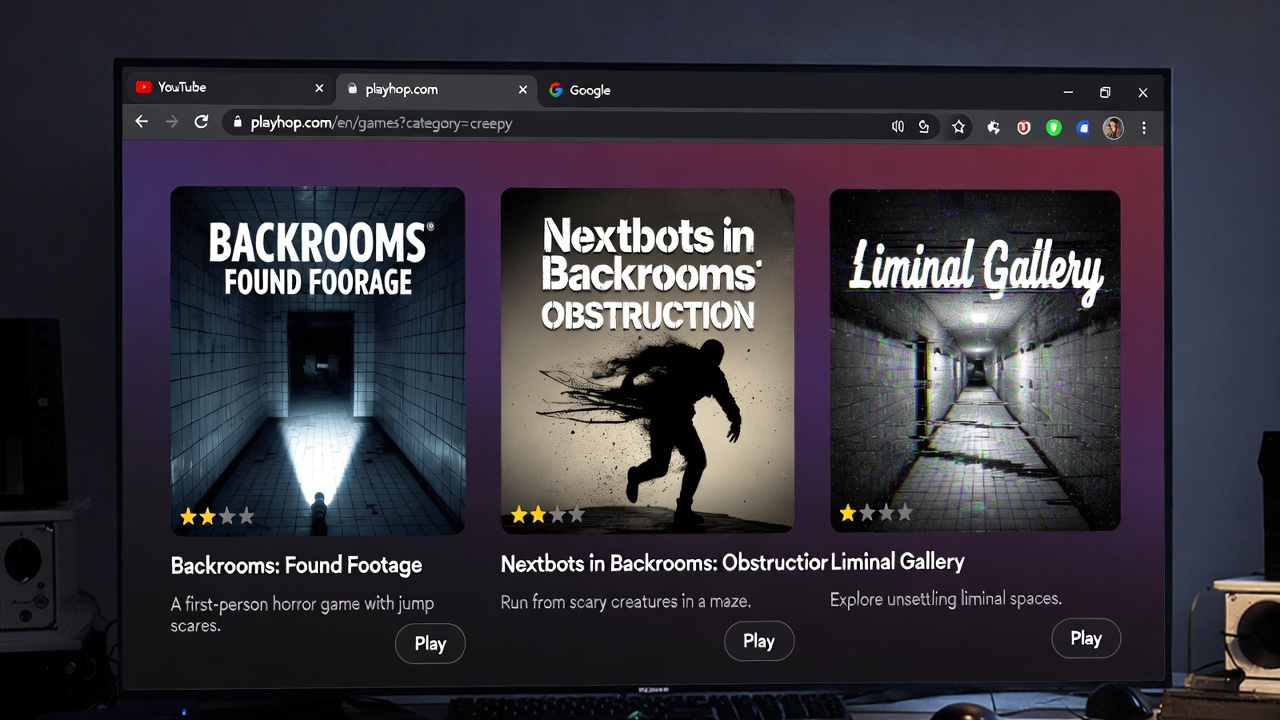
Browser horror has a special kind of power. You don’t boot up a 70 GB install or commit to a 10-hour campaign – you just click, go fullscreen, and suddenly you’re alone in a place that feels like a memory you can’t quite place. The best part? These games hit hard in short sessions, which is perfect when you want a quick scare without wrecking your whole night.
This collection of creepy games is a great place to sample the Backrooms / chase-style trend.
What makes this wave so addictive is how different the scares feel. Backrooms-style games lean into slow dread, navigation, and “did I just hear that?” tension. Nextbot chasers go the opposite direction: pure panic, loud footsteps, and split-second choices. Then you’ve got liminal-space horror that’s basically vibe-based damage over time – no monster required, just weird architecture and the feeling you shouldn’t be here.
Why Liminal-Space Horror Works So Well in a Browser
Liminal spaces are “in-between” places: hallways, empty malls, office corridors, parking garages. They’re familiar, but wrong in a way that makes your brain start writing scary fanfic in real time. In a browser, that effect gets even stronger because it feels like you’ve opened a forbidden tab and stepped into it.
The medium helps, too. Short draw distances, simpler textures, and basic lighting can actually make the vibe nastier. When details are missing, your imagination fills the gaps – and your imagination is a menace.
The Backrooms Loop: Dread, Navigation, and “Did I Just Hear That?”
The Backrooms vibe is all about getting lost on purpose. The halls repeat, the carpet looks damp, and every turn feels like it might be the one where the game finally “shows its hand.” Even when nothing is chasing you, you’re still moving like something is.
What makes a strong Backrooms-style browser game
The good ones don’t rely on nonstop jumpscares. They make you fear the atmosphere and uncertainty. You’ll usually feel it in three places: the layout messes with your sense of direction, the audio is doing quiet work (hum-buzz, distant thuds, echoes), and the objective is simple but stressful (find an exit, restore power, locate a door) without turning into a homework assignment.
Play tips that keep it scary (not frustrating)
Backrooms games can accidentally become “I’m lost and annoyed” simulators. The fix is mostly mindset and setup. Go fullscreen and use headphones. Keep your sensitivity steady so you’re not overcorrecting every corner. If there’s a brightness slider, don’t blast it to daytime; let the shadows stay suspicious. And when you’re wandering, pick tiny landmarks – a crooked chair, a stain, a flickering light – so you’re not purely guessing.
Nextbots and Chase Horror: When the Jumpscare Has Footsteps
Chase-style horror is basically cardio for your thumbs. The tension isn’t “what’s in the dark?” – it’s “how far away is it right now?” These games are popular because the threat is readable, the rules are usually clear, and the fun comes from how fast a normal run turns into an absolute sprint.
What “nextbot” means in this context
Online, “nextbot” has become shorthand for an enemy that hunts you down using pathfinding – the thing knows where you are (or quickly figures it out) and closes the gap. The term itself is closely tied to the Source-engine era of bot AI and community tools, which is why you’ll see NextBot referenced in modding docs even when the horror version is a simplified “chase you forever” remix.
Survive chase games without turning it into cheese
- Keep moving, but don’t sprint blindly. The fastest death is committing to a dead end with zero info.
- Learn one reliable loop per map (a hallway loop, a stair loop, a room with multiple exits). You’re not exploiting, you’re navigating.
- Use corners and doors to reset the situation. Even simple AI often hesitates when you disappear or force a reroute.
- If there are stamina or item mechanics, treat them like panic buttons, not your default movement. You want them available when things go loud.
Liminal Vibes Beyond the Backrooms
Not every liminal horror game needs lore or monsters. Some of the creepiest browser experiences are basically interactive mood pieces: you wander, you notice little inconsistencies, and the game lets your nerves do the heavy lifting. These are great palette cleansers between louder chase games because they’re less about reflexes and more about attention.
One small trick: play these when you’re not distracted. Liminal horror dies instantly if you’re scrolling your phone. It’s like trying to watch a scary movie while reading chat – the spell breaks.
A Quick “Is This Worth My Time?” Checklist
When you’re hopping between browser horror tabs, you’ll run into a lot of “cool idea, rough execution.” Before you commit, do a 30-second scan:
- Does it run smoothly and accept basic inputs without fighting you?
- Are the audio levels balanced, or is it all max-volume screeching?
- Is the objective clear enough to start, even if the mystery comes later?
- Do the visuals create readable spaces, not just pure darkness?
- Does failure teach you something, or is it random?
- Is there a way to pause or exit cleanly?
Where This Trend Is Headed
The Backrooms/liminal/nextbot wave keeps evolving because it’s flexible. Developers can make something spooky with limited assets, and players can jump in instantly. Expect more mashups: liminal exploration that flips into a chase halfway through, or nextbot panic that dumps you into a quiet “wrong” space afterward. That contrast is nasty – and it works.
If you’re hunting for a quick, zero-install scare, treat browser horror like a playlist. Try a slow dread game, then a chase, then a liminal wanderer, and you’ll start noticing what kind of fear hits you hardest.