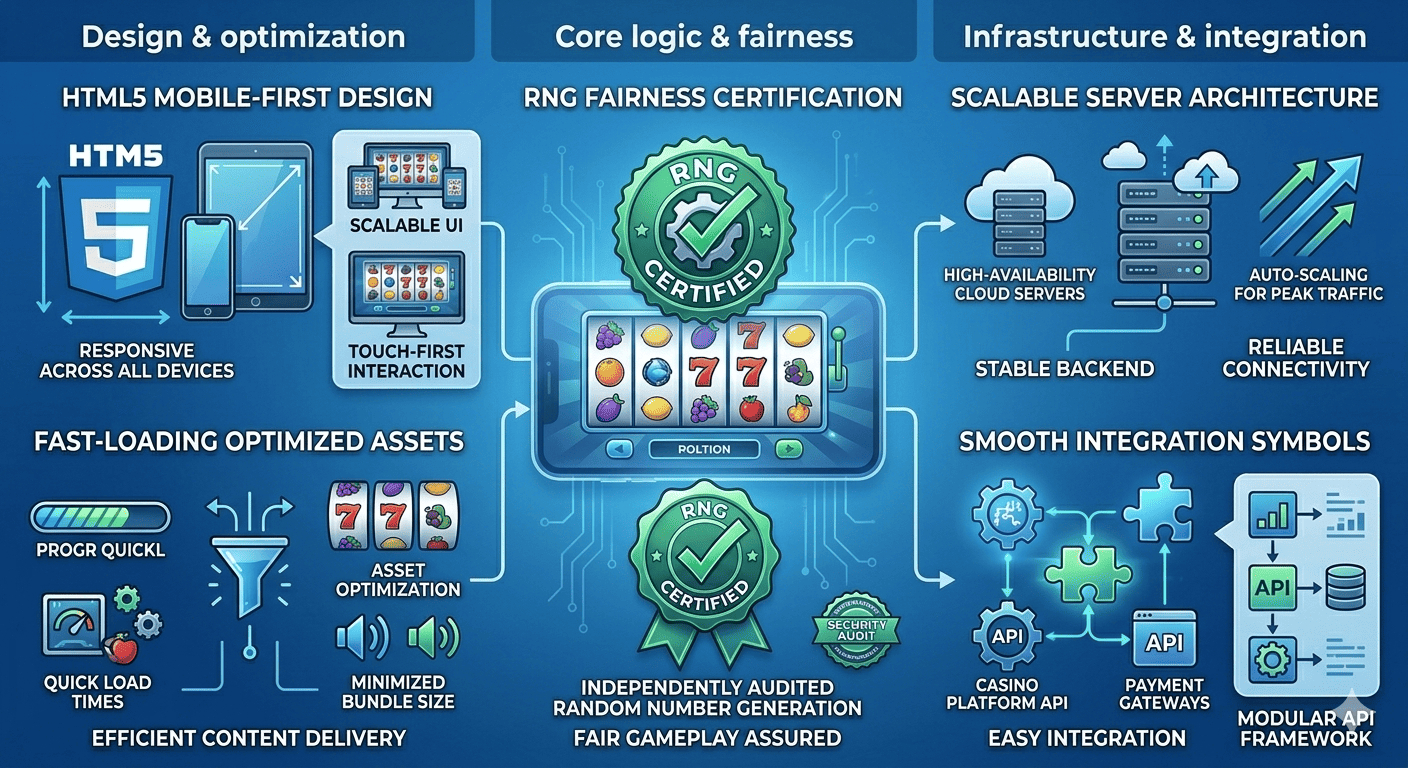

Behind every online casino, sportsbook or lottery sits a stack of software that players never see and operators cannot run without. iGaming software development is the discipline of building that stack — the game clients, math engines, wallets, back offices and integrations that turn a gambling licence into a working product. Whether you are an operator evaluating platforms, a startup scoping a build, or a company deciding how much to develop in-house, the same map applies: what the software includes, how it is built, which platform models exist, what certification demands, and when building beats buying. This guide covers all of it in operator terms.
What iGaming Software Includes
An iGaming platform is best understood as six interlocking subsystems:
- Game clients — the HTML5 games players interact with: slots, table games, crash and instant-win formats, each rendering the interface while all game logic runs server-side.
- Math engine and RGS — the certified server-side core that generates outcomes, enforces RTP and volatility targets, and settles every round against player balances. For casino operations this is the revenue-critical component.
- Wallet and payments — real-time balance management, multi-currency and crypto support, payment provider integrations, deposits and withdrawals with AML-relevant transaction monitoring.
- Back office — the operator’s control room: player management, bonus and campaign tooling, risk and fraud controls, game configuration, limits, reporting dashboards.
- Aggregation layer — connectors to game providers and aggregators, so one platform surfaces hundreds of third-party studios’ content alongside first-party games.
- Reporting and compliance — GGR/NGR reporting, jurisdiction-specific regulator feeds, responsible-gaming tooling, audit trails and data retention that satisfy licence conditions.
The coupling matters more than the list: a wallet that cannot settle a provably fair game in real time, or a back office that cannot enforce self-exclusion across every game server, is not a feature gap — it is a compliance failure. Mature platforms are designed around these couplings; assembled ones bolt them on and leak.
The Tech Stack
Most serious iGaming builds in 2025 converge on a recognisable stack:
| Layer | Common choices | Why |
|---|---|---|
| Game clients | HTML5, Canvas/WebGL (PixiJS, Phaser), TypeScript | One codebase across desktop and mobile; no plugins; app-store-independent distribution |
| Backend services | Node.js or Go for high-concurrency services; Elixir and Java in some betting cores | Real-time event handling and high concurrent session volumes at predictable latency |
| Databases | PostgreSQL as the transactional core; Redis for session/cache; columnar stores for analytics | Financial-grade transactional integrity first; analytics layered separately |
| Real-time layer | WebSockets with load-balanced stateful gateways | Live games, crash formats and sportsbook feeds need persistent connections |
| Payments and crypto | Provider connectors plus wallet infrastructure; chain integrations where crypto is in scope | Settlement speed and payment breadth are conversion-critical |
| Infrastructure | Cloud (AWS/GCP/Azure), containers, IaC, multi-region where latency or regulation demands | Uptime is contractual; scaling must survive peak sports and promo events |
Two engineering constraints shape everything else. Financial integrity: every bet, win and bonus movement must be ledger-exact and auditable — eventual consistency is unacceptable in settlement paths, which pushes architecture toward idempotent operations and strict reconciliation. Regulatory traceability: outcomes, RG interventions and account events must be reconstructable for auditors years later, which affects data modelling more than any performance requirement.
Platform Types: Turnkey, White Label, Custom
Three delivery models dominate, and choosing between them is mostly a decision about control versus speed:
- White label — the fastest path to market: the provider supplies platform, licence (often), games and payments under a revenue-share or fee model; the operator brings brand and traffic. Launch in weeks, minimal technical control, and the provider’s roadmap constrains your differentiation.
- Turnkey — the provider delivers the full platform under your licence, configured for your markets: more control than white label, more operational burden (you run compliance and operations), typically a setup fee plus monthly/rev-share terms.
- Custom development — building the platform (or distinctive parts of it) with a development partner: maximum differentiation and IP ownership, 9–18+ months to a production-grade platform, and a heavy compliance engineering load from day one.
The pragmatic pattern among serious operators is hybrid: launch on turnkey or white label to validate the market, then custom-build the components where differentiation actually lives — proprietary games, unique gamification, custom bonus engines — while keeping commodity infrastructure licensed. Pure custom-from-scratch platforms make sense mainly when the product itself is the differentiator (a novel game format, a crypto-native architecture, a licensed niche vertical like lottery platform development, where draw integrity and regulator-specific mechanics rarely fit generic casino platforms).
Certification and Compliance
iGaming software is certified, not just tested. What that means in practice:
- Game certification — accredited labs (GLI, BMM, iTech Labs and jurisdiction-specific bodies) test RNG quality, game logic correctness, RTP accuracy and feature behaviour per title, per market.
- Platform certification — key markets (notably MGA jurisdictions) extend testing to platform-level controls: settlement integrity, RG tooling enforcement, data protection, audit trails.
- Jurisdictional requirements — MGA (Malta) demands rigorous technical and organisational compliance; Curaçao offers a lighter framework historically used for crypto-facing operations, though its reform has tightened requirements; UK, Sweden, Ontario and others add market-specific mandates on RG, advertising and data.
- Continuous obligations — version changes, new games and feature updates require change management and sometimes re-testing; compliance is an operating cost, not a launch checkbox.
Budget and schedule accordingly: certification routinely adds 4–12 weeks per market cycle and meaningfully shapes architecture — for instance, the requirement that game logic be server-side and tamper-evident is a design constraint, not a review note. Teams that treat compliance as an afterthought pay for it in lab re-submissions and delayed launches.
Build vs Buy
The decision reduces to three honest questions:
- Is the platform your differentiator? If your edge is content, brand or acquisition, buy the platform and invest in the edge. If the product itself is novel (a new game format, a crypto-native model), the differentiating core justifies custom engineering.
- What is your time-to-revenue? White label can trade in weeks; turnkey in months; custom in a year or more. In most markets, validated revenue and player data earlier beats architectural elegance later.
- What can you operate? Custom software makes you the vendor: 24/7 operations, security patching, compliance change management, and an engineering team that must include iGaming-specific competence (math certification, payment rails, regulator reporting). The build cost is visible; the operating cost is larger and permanent.
For most operators the answer is: buy the platform, build the content. Casino content is where differentiation compounds — which is why content strategy usually starts with the games. If that is your direction, scoping a custom game line with an experienced casino game development partner is the higher-leverage investment than rebuilding wallet and back-office plumbing that proven platforms already solve. Keep certification and integration experience as the non-negotiables in either path: they are the components most often missing from cheap quotes.
Frequently Asked Questions
What does iGaming software development cost?
Custom game development starts in the low tens of thousands of euros per title; a custom platform is a multi-hundred-thousand-to-million-euro programme depending on scope. White label and turnkey models trade large upfront cost for setup fees plus monthly or revenue-share terms — the comparison should be total cost of operation over three years, not the launch invoice.
How long does it take to build an iGaming platform?
A production-grade custom platform typically takes 9–18+ months including certification; turnkey launches commonly run 2–4 months; white label can go live in weeks. Certification and integration are usually the schedule’s critical path, not development.
Which tech stack is best for iGaming?
The proven pattern is HTML5/TypeScript game clients, Node.js or Go backend services, PostgreSQL for the financial core, Redis for session state, and WebSocket-based real-time layers. Stack choice matters less than financial-integrity architecture and compliance-grade audit trails — those are what labs and regulators actually test.
Is white label the same as turnkey?
No. White label runs under the provider’s licence and infrastructure with you as the brand; turnkey delivers a full platform configured for your own licence, so you carry operational and compliance responsibility. White label is faster and lighter; turnkey gives more control and market independence.
What certifications does iGaming software need?
Per game and per market: RNG and game-logic testing by accredited labs (GLI, BMM, iTech Labs) for regulated jurisdictions, plus platform-level certification where the market requires it (notably under MGA). Crypto-facing operations under lighter regimes still benefit from certifiable designs, which preserve every future market option.
Gambling disclaimer: this article is written for industry professionals — operators, startups and development teams — and describes software development and compliance processes. It is not gambling advice. Online gambling involves financial risk; operators must hold valid licences in their target jurisdictions and comply with applicable regulations and responsible-gaming requirements.