
A turnkey online casino is the shortest distance between a business plan and a live gambling operation. Instead of assembling a platform, game content, payments and compliance one piece at a time, the operator receives a pre-built, configured stack and concentrates on the two things a vendor cannot supply: the brand and the players. For casino operators and gambling startups, the model trades some flexibility for speed and predictability. This article breaks down what a turnkey casino solution includes, what it deliberately leaves out, which factors move the budget, and how long a realistic launch takes.
What Is a Turnkey Online Casino?
A turnkey online casino is a complete gambling platform delivered ready to operate under the client’s own brand and license. The vendor supplies the technology layer — game aggregation, wallet, payments, back office, bonus engine, reporting — and the operator supplies the business: the license application, brand, marketing, customer support and the P&L. The defining feature is that you own the operation. Unlike a white label arrangement, where you run under someone else’s license and platform, a turnkey casino makes your company the licensed entity from day one, and that shapes everything from margin to exit options later.
In practice, “turnkey” does not mean “zero work”: the heavy engineering is done, and the remaining tasks are regulatory and commercial — license, payment providers, bonus policy, game catalog. A competent vendor sequences them so certification and license conditions are met before the first deposit is accepted.
What’s Included in a Turnkey Casino Package
Packages differ between vendors, but a serious turnkey casino solution covers the following core modules:
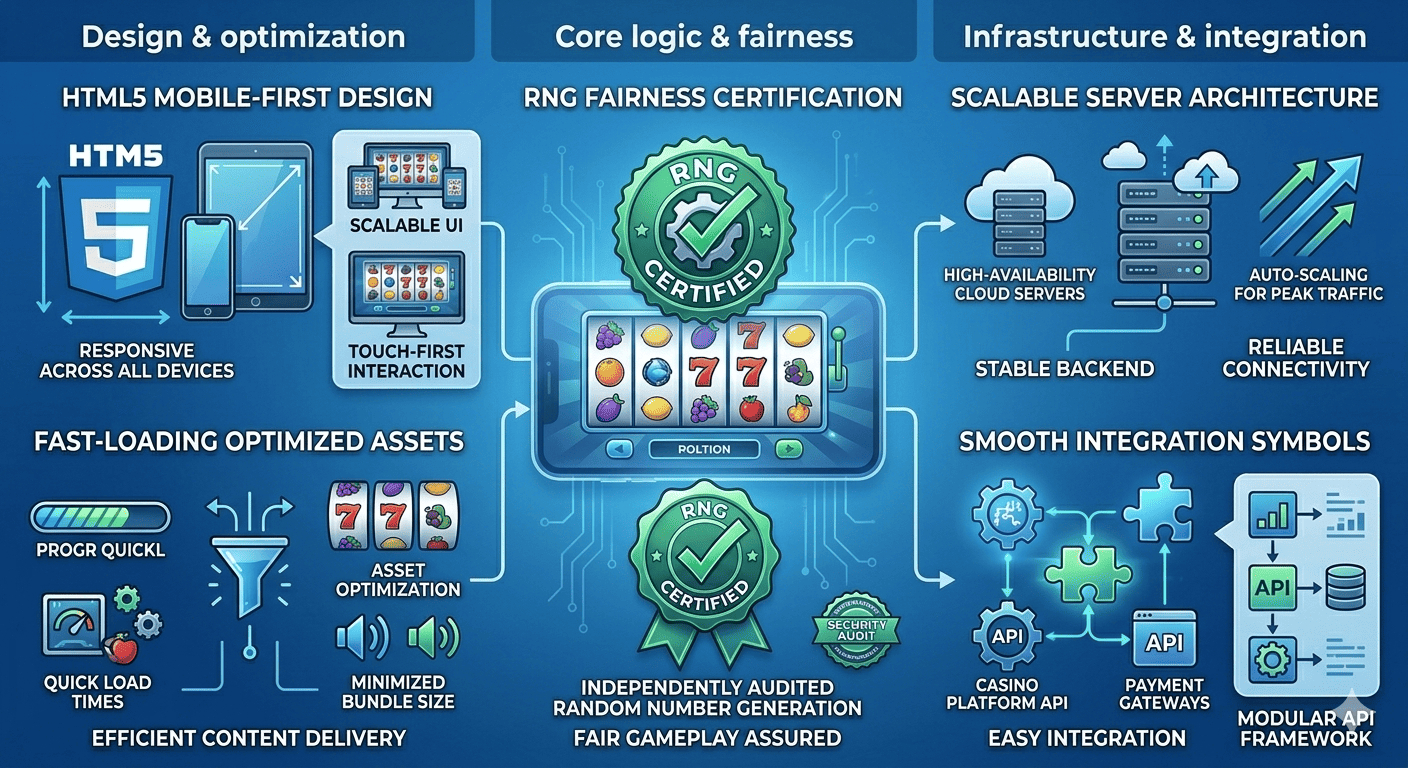
- Game aggregation: a catalog of certified slots, table games and live casino titles connected through a single API, so content from multiple studios lands in the lobby without dozens of separate integrations.
- Player accounts and wallet: registration, KYC touchpoints, multi-currency balances, transaction history and session management.
- Payments: integrations with payment service providers — cards, bank transfers, e-wallets and, where the market allows, crypto — with deposit and withdrawal flows configured per market.
- Back office: player management, verification queues, deposit and loss limits, risk flags and manual intervention tools for the support team.
- Bonus engine: welcome packages, free spins, reloads and cashback with wagering rules enforced automatically.
- Reporting: GGR and NGR dashboards, game performance, player cohorts and financial reconciliation for both management and the regulator.
- Licensing support: the technical documentation a regulator expects — system architecture, RNG statements, responsible gambling tooling descriptions — plus compliance modules such as self-exclusion and reality checks.
- Infrastructure and SLA: hosting or cloud deployment, monitoring, security hardening and a defined support agreement.
What a Turnkey Casino Does Not Include
Vendors rarely hide this list, but buyers still get surprised by it:
- The license itself. Turnkey includes licensing support, not the license. The permit is issued to your legal entity, and the government fees, local deposits and advisory costs are yours.
- Marketing and player acquisition. SEO, affiliate programs, paid media and CRM campaigns are operator work; no turnkey package fills a lobby with players.
- Unique game content. The catalog comes from aggregators and shared studios. Exclusive or branded games — the kind that genuinely differentiate a lobby — are a separate development scope with a game studio.
- Business decisions. Bonus policy, market selection, payment mix and your responsible gambling stance remain with you; the platform only enforces what you configure.
Core Components of a Turnkey Casino Solution
From an engineering point of view, a turnkey casino is a set of subsystems that must pass certification together. The table maps each component to what it does and why it matters.
| Component | What it does | Why it matters |
|---|---|---|
| Game aggregation hub | One API to many certified studios; unified balance across games | Breadth of content without maintaining dozens of integrations |
| Wallet and cashier | Balances, multi-currency, deposit and withdrawal routing to PSPs | Deposit success rate is a direct conversion lever |
| Back office | Player management, limits, KYC queues, risk and fraud flags | Where daily operations and license conditions are executed |
| Bonus engine | Rules-based promotions with automatic wagering enforcement | The main retention mechanism, and a compliance-sensitive one |
| Reporting and BI | GGR/NGR, game mix, cohorts, regulator-ready exports | Turns operations into decisions and keeps filings clean |
| Responsible gambling module | Self-exclusion, limits, reality checks, session reminders | A condition of every serious license, not a nice-to-have |
| Certified RNG foundation | Game outcomes and RNG handling aligned with lab requirements | Accredited labs such as GLI and eCOGRA test this before launch |
If you want the technical side of the last row explained, we have a dedicated article on the role of RNG in online slots, covering what labs actually verify and why outcomes cannot drift over time.
Turnkey Casino Cost: What Actually Moves the Number
Anyone quoting a single price for a turnkey online casino before scoping is guessing. Platform setup is usually the smallest line item; six other factors dominate the budget:
| Cost factor | How it changes the budget | Practical note |
|---|---|---|
| Licensing jurisdiction | Government fees, local presence requirements and compliance overhead differ by an order of magnitude between regulators | MGA-class licenses typically cost more and take longer than Curaçao-based setups; weigh both against your target markets |
| Commercial model | Flat platform fee per month vs revenue share on GGR/NGR | Revenue share lowers the upfront barrier but becomes the dominant cost at scale; model both over three years |
| Game integration | Aggregator-led catalog vs direct integrations with studios | Aggregators are faster and cheaper to start; direct deals improve margins as volume grows |
| Custom development | Depth of branding, bespoke features, exclusive games | Treat as a separate scope with its own estimate, not part of the base package |
| Certification and testing | Independent lab testing of the platform and game content per market | Scope depends on jurisdictions and the number of games; budget time as well as fees |
| Payments | PSP setup fees, processing terms for gambling-classified merchants, rolling reserves | Terms vary widely for high-risk merchants; confirm them before committing to a market |
Two factors deserve emphasis. Licensing determines not only fees but which markets you may legally target, so choose it backwards from your intended player base, not forwards from its price. And a revenue-share agreement that looks cheap in month one can quietly become the largest cost of ownership by year three — a serious vendor will model both scenarios with you; resistance to that conversation is itself a data point.
Timeline: From Decision to Live Casino
Generic industry ranges hold for most operator launches:
Licensing: roughly 3–9 months. The license is the long pole: processing time depends on the jurisdiction, your documentation and background checks on owners and key persons. Start it in parallel with everything below.
Platform setup and configuration: typically 2–6 weeks. Branding, wallet and currency configuration, bonus policy, back-office roles and payment provider connections for your first markets.
Game content integration: 1–3 weeks. With an aggregation hub, loading and QA-ing several hundred titles is routine; direct integrations take longer per provider.
Certification and compliance sign-off: typically 4–8 weeks. Independent testing of RNG and platform behaviour, plus market-specific approvals, should run alongside the final stage of licensing.
Taken together, many operators go live within roughly four to nine months of signing, with the license — not the technology — deciding where in that range you land. The same staging applies to adjacent verticals such as lotteries, which follow a comparable sequence on a dedicated platform.
Launch Checklist Before You Sign
Before committing to a vendor, put these items on the table explicitly:
- Confirm in the contract that you own the player database and can export it in a usable format — this single clause decides your exit options later.
- Separate what the vendor supplies for licensing (documentation, compliance modules) from what your legal counsel must produce.
- Run a full deposit and withdrawal cycle with real payment providers in a sandbox before go-live, not after.
- Verify that game certifications are valid in your target markets, not just somewhere.
- Negotiate revenue-share terms with minimums, caps and a documented migration path out of the contract.
- Agree measurable SLAs: uptime, incident response times, payment reconciliation frequency.
FAQ
How much does a turnkey online casino cost?
There is no single figure, and any precise number quoted before scoping is a placeholder. The budget is driven mainly by the licensing jurisdiction, the commercial model (flat fee vs revenue share), the volume of game content and any custom development. For most projects, licensing and long-term revenue share outweigh the platform setup fee several times over.
Does a turnkey casino solution include the license?
No. The vendor provides licensing support — technical documentation, compliance tooling, regulator communication — but the permit is issued to your company and the associated fees are yours. Arrangements where you operate under someone else’s license are white label, which is a different model with different trade-offs.
How long does certification take?
Where markets require it, independent testing by accredited labs such as GLI or eCOGRA typically adds four to eight weeks, depending on the number of games and jurisdictions in scope. Plan it in parallel with licensing, not behind it.
Can I add new games or my own slots later?
Yes, provided the platform exposes an open aggregation API. Most operators keep expanding the catalog after launch, and some eventually commission exclusive titles. Custom slot development integrates through the same layer, so a game you own sits next to aggregator content in the same lobby.
Gambling involves risk. Please play responsibly. This article is for informational purposes only.
Plan Your Turnkey Launch With a Game Studio
If you are evaluating a turnkey online casino and want a second opinion on which parts of the stack are worth owning versus renting, talk to the team that builds the games themselves. EJAW provides full-cycle casino game development — from game design and math models to certification-ready builds — and applies the same approach to lottery platform development. Tell us your target markets and where your license process stands, and we will map the fastest realistic route to launch.