
Mobile gaming is now a $100+ billion industry, and the old playbook for making money is being thrown out. Games used to pick a lane — either show ads, or sell things inside the game. That’s over. The studios winning in 2026 are doing something more interesting, and sometimes more uncomfortable: they’re combining everything at once, cutting out the middlemen, and using AI to figure out exactly how much each individual player is willing to spend.
This piece breaks down four big shifts happening right now, what they mean in practice, and what developers should actually do about them.
Games That Mix Ads and Purchases — And Do It Well
The Old Fight Is Dead
For years, mobile game studios acted like ads and in-app purchases were enemies. Premium game makers thought showing ads was embarrassing. Casual game makers thought charging for things inside the game would scare users away. Both sides had a point. Both are now missing the bigger picture.
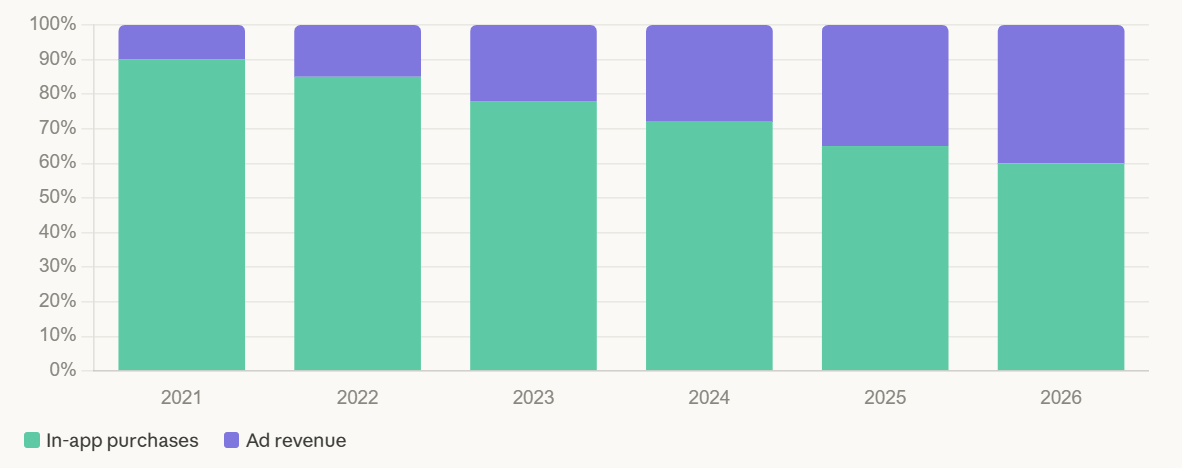
The games making the most money in 2026 do both — and they’re deliberate about how they do both. We call this the hybrid model. Roughly speaking, it means a game where neither ads nor purchases makes up more than about 75% of the revenue. The split in top-performing games today is often something like 60% purchases, 40% ads — a massive change from five years ago when it was closer to 90/10.
But the real story isn’t the ratio. It’s how the two systems are connected.
One of the clearest early examples of this thinking didn’t even come from traditional mobile gaming. The sweepstakes casino model — where players use virtual coins purchased outside the main payment flow, with rewards delivered through a separate system — essentially forced developers to engineer a clean separation between “payment moment” and “reward moment.” That architectural thinking is now showing up everywhere in hybrid mobile games. When the payment and the reward are decoupled, you get more flexibility in how and when you monetize. More on why this matters in the web shop section below.
Lock Progress Behind Purchases — The Brawl Stars Approach
Brawl Stars doesn’t just sell you cosmetics. It sells you forward momentum. When a player hits a wall in their progression — a brawler they can’t unlock, a league they can’t climb — the game presents a purchase option at the exact moment of frustration. This is called progression-gated monetization, and it works because the emotional context is perfect. The player already wants something. The game is simply offering a shortcut.
This is meaningfully different from the old model of just putting a shop in the menu and hoping someone clicks. The purchase is triggered by behavior, not by a banner.
Survivor.io uses a similar approach but leans harder into the early-game experience. New players are shown aggressive but relevant offers in their first three sessions, when curiosity and engagement are at their peak. After that window, the offers become less frequent and more personalized. The logic is sound: a player’s willingness to spend is highest when they’re still figuring out if they love the game.
Social Pressure Is a Monetization Tool
One of the most underappreciated levers in mobile monetization right now is the clan or club system. When a player belongs to a group — a guild, a club, a crew — their behavior changes. They log in more. They stay longer. And critically, they spend more, because they’re spending in a social context rather than a private one.
Games that integrate spending into club mechanics — clan wars, group leaderboards, club-exclusive content — are seeing their average revenue per user climb significantly compared to games with identical core loops but no social layer. The psychological mechanism is simple: nobody wants to be the weakest member of their group.
What should a developer do? Build your social layer before you build your shop. The social infrastructure is what makes the shop worth something. If you’re adding a clan system as an afterthought after launch, you’re leaving real money on the table. Design clan contribution mechanics so that light spenders can participate meaningfully — this keeps the ecosystem healthy and prevents the “pay-to-dominate” perception that kills communities.
Cutting Out the App Store — The Web Shop Revolution
The 30% Problem
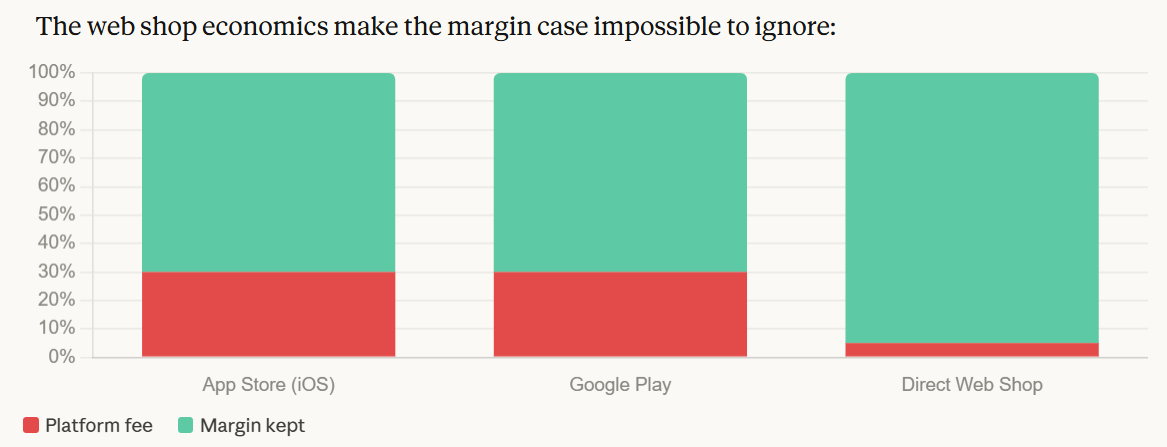
Here is a fact that every mobile developer knows and almost nobody outside the industry appreciates: for every dollar spent inside an iOS or Android app, Apple or Google takes 30 cents off the top. For years, this was simply the cost of doing business. The platforms owned the relationship with the customer, and developers had no alternative.
That is now changing, significantly and permanently, due to two legal and regulatory forces converging at the same time.
What the Courts and Regulators Did
In the United States, Epic Games spent years fighting Apple in court over the right to direct players to outside payment options. The result was a messy compromise — Apple still controls the in-app purchase system, but developers can now communicate with users about alternative ways to pay. A game can tell a player, “You can buy this on our website for less.” For years, that sentence alone was grounds for being removed from the App Store.
In Europe, the Digital Markets Act (DMA) went further. It classified Apple and Google as “gatekeepers” and required them to allow alternative payment systems and app distribution. The enforcement is still imperfect, but the direction is clear: the 30% platform tax is being chipped away by regulators on both sides of the Atlantic.
What a Web Shop Actually Looks Like
A web-to-game shop is exactly what it sounds like. Instead of purchasing gems or a battle pass inside the game, a player visits a webpage — owned and operated by the developer — makes a purchase there, and the content appears in their game account.
The economics are dramatically different:
| In-App Purchase (App Store) | Direct Web Shop | |
| Platform Fee | 15–30% | 3–8% (payment processor only) |
| Margin Kept | 70–85% | 92–97% |
| Setup Complexity | Minimal | Significant |
| User Experience | Seamless, one tap | Extra steps, browser redirect |
| Customer Data Owned? | No — Apple/Google own it | Yes — full purchase history |
| Fraud Protection | Handled by platform | Developer’s responsibility |
| Refund Handling | Platform managed | Developer managed |
The margin improvement is obvious. But the friction cost is real. Studies on web shop conversion show that every extra step a user has to take — open browser, log in, enter payment details — reduces conversion. The developers who are succeeding with web shops are investing seriously in making that flow as fast as possible: saved payment methods, single sign-on, QR codes inside the game that open directly to a pre-filled cart.
The Technical Headache: Keeping Purchases in Sync
The problem nobody talks about in web shop coverage is what happens after the purchase. When someone buys something inside the game, the game engine knows instantly. When someone buys something on a website, the game has to be told. This requires a backend system that listens for purchase confirmations, validates them, and then delivers the right items to the right account — reliably, quickly, and without duplicating orders.
Edge cases multiply fast: What if the player buys on the web but their game client is offline? What if the payment processor confirms but the game server is down? What if a refund is issued on the web side but the in-game item was already consumed? Studios that have launched web shops without a robust backend have faced customer support disasters and significant chargebacks.
What should a developer do? Don’t launch a web shop until you have three things: a reliable delivery backend, a customer support team trained for payment disputes, and a tested fraud prevention layer. Start with Android, where the regulatory environment is more permissive. Use the web shop for your highest-value purchases — large currency bundles, annual passes — where the margin improvement justifies the added friction. Don’t try to replace the in-app store; treat the web shop as a complementary channel for your most engaged players.
Battle Passes Grew Up
Why the Original Battle Pass Was a Blunt Instrument
The original battle pass — popularized by Fortnite, copied by essentially every live service game — was a clever idea that the industry immediately over-replicated. Pay $10, do daily tasks, unlock cosmetics over a season. Simple, predictable, and enormously successful in its first cycle.
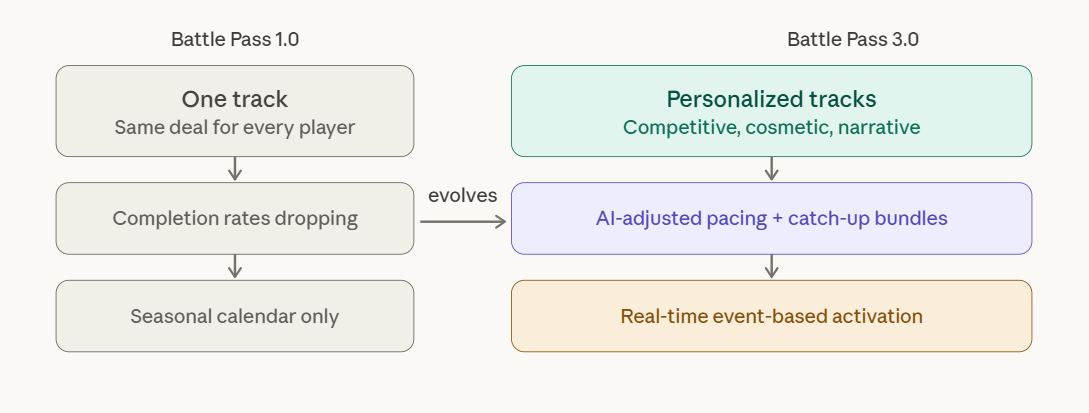
The problem: it’s the same deal for every player. A hardcore player who logs in four hours a day and a casual player who logs in four times a week are offered identical value at an identical price. That’s not personalization. That’s a mass-market product dressed up as engagement.
Player fatigue with generic battle passes is measurable. Completion rates — the percentage of pass buyers who actually finish the pass — have dropped significantly across the industry. When players feel like the pass is too much work or not worth the grind, they don’t renew.
What Battle Pass 3.0 Actually Means
The next generation of the battle pass is not a seasonal product. It’s a dynamic contract between the game and the individual player, adjusted continuously based on behavior.
Here’s what that looks like in practice:
- Personalized track selection. Instead of one linear progression, the game offers multiple tracks — a competitive track, a cosmetic track, a narrative track — and lets players choose where to spend their energy. Retention improves because players are progressing toward things they actually want.
- AI-adjusted pacing. If the system detects that a player is falling behind their pass completion pace, it quietly adjusts. It might surface an easier bonus objective, or offer a small catch-up bundle. The player doesn’t feel like they’re losing. They feel like the game understands them.
- Event-based activation. The most sophisticated studios are no longer waiting for a calendar season to launch monetization events. They’re watching for engagement spikes in real time — a viral moment, a content creator posting about the game, a region-specific holiday — and triggering targeted offers within hours of the spike.
What should a developer do? Segment your pass buyers by play style before you design the pass. Start with two tracks rather than five — complexity has its own friction cost. On the AI side, the minimum viable version is a simple rule: if a player hasn’t logged in for 3 days and has less than half their pass complete, trigger a push notification with a catch-up offer. You don’t need a machine learning team to start.
The New Numbers That Actually Matter
Why “Cost Per Install” Became Misleading
Cost Per Install was the dominant metric in mobile marketing for years. How much does it cost to get someone to download your game? Lower CPI meant a more efficient campaign. Simple.
The problem is that an install is worth almost nothing by itself. A player who downloads a game and deletes it in 20 minutes cost you $3 and generated zero revenue. A player who downloads a game and spends $50 over six months cost you the same $3 and generated a huge return. CPI cannot tell you which player you acquired.
The industry has moved toward ROAS at Day 90. ROAS stands for Return on Ad Spend. D90 ROAS asks: for every dollar we spent acquiring users through this campaign, how many dollars did those users generate within 90 days? This rewards fundamentally different decisions than CPI ever did.
The Problem With Chasing Big Spenders Only
The old model was built around whales — the 1–3% of players who make very large purchases and account for a disproportionate share of revenue. This still works, but it’s increasingly fragile for clear reasons:
- The whale pool isn’t growing. The number of games competing for high spenders is rising faster than the high spenders themselves.
- Whales are emotionally volatile. One badly-designed monetization event can trigger a spending boycott that spreads through a community within 24 hours.
- Over-reliance creates revenue cliffs. When a single whale leaves or gets banned, the revenue impact is immediate and visible.
- Mid-tier spenders are being ignored. A player spending $5–15 per month gets almost no design attention in whale-focused games — and they leave because nothing feels made for them.
The studios building durable businesses right now are expanding their revenue base downward. Two hundred thousand players spending $10 a month is more stable, more predictable, and ultimately more valuable than two thousand whales — and far less likely to collapse overnight.
Retention Is the Real Monetization
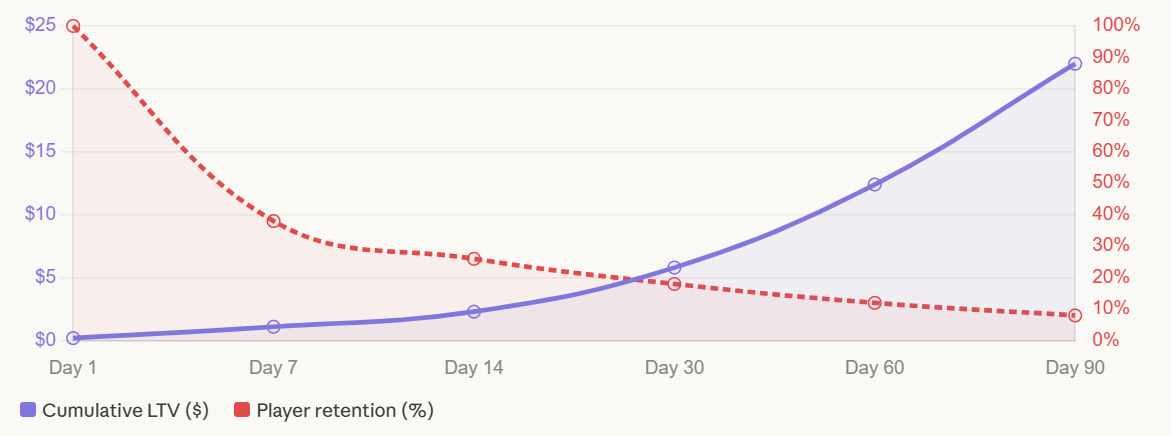
Here is the most important reframe in this entire piece: retention is not a prerequisite for monetization. Retention is monetization.
A player retained to Day 90 has found enough value in your game to keep coming back for three months. Their total lifetime value is exponentially higher than a Day-7 retained player. Every design decision that improves D90 retention is a direct revenue decision, not just a product decision.
This is why the top studios now run their game design teams and their monetization teams together. The people designing daily login rewards are doing monetization work. The people designing the mid-game progression curve are doing monetization work. The separation between “game design” and “monetization” was always artificial — it’s now commercially indefensible.
What should a developer do? Audit your metrics setup before you audit your monetization system. If you cannot measure Day 30, Day 60, and Day 90 retention by acquisition source, you are flying blind. Build that reporting first. Then set a D90 ROAS target for each marketing channel and cut any channel that hasn’t hit it within two cohort cycles. Redirect that budget toward content updates that improve mid-game retention — this will generate better long-term returns than any ad creative optimization.
Final Word
None of these shifts are complicated in theory. Hybrid monetization, web shops, personalized passes, retention-focused metrics — every developer reading this has heard these ideas. The gap is not in awareness. It’s in execution.
The studios that will define the next five years of mobile gaming are not the ones with the most creative ideas. They’re the ones building the operational infrastructure — the data pipelines, the backend systems, the cross-functional teams — to execute on ideas the whole industry already knows are right.
The blueprint exists. The question is whether your studio has the discipline to build it.