
Commissioning a slot is not like commissioning a website. Slot game development services span mathematics, art production, real-time client engineering, server architecture, and regulatory certification — and the phases run partly in sequence, with the math model gating everything downstream. Operators and studios that outsource production get predictable results only when they understand what each phase delivers and who is responsible for it. This article walks through the full lifecycle of custom slot development, phase by phase, with the deliverables and the team roles you should expect to see at every step.
Phase 1: Concept and Market Fit
Production starts with a game concept document, not with art. The team defines the theme and visual direction, the target markets and their regulatory constraints, the feature set (base game mechanics, free spins, bonus games, feature buy where permitted), and the commercial targets: RTP range, volatility class, and maximum win potential. The outputs are a game design document (GDD) and a signed-off creative brief. Skipping the market-fit step is how games end up certified but unpublishable in their target jurisdiction — for example, bonus-buy features that certain regulators restrict, or a maximum prize that exceeds a market’s rules.
Phase 2: Math Model and Simulation
The mathematician turns the GDD into a working model: paytables, reel strips or symbol distributions, payline, ways, or cluster definitions, and the exact logic of every bonus feature. The model is then simulated across millions — often billions — of rounds to verify the theoretical RTP sits inside the target range (typically in the mid-90s percent for online slots), to measure volatility and hit frequency, and to confirm the maximum win cap. The deliverable is the PAR sheet — the paytable and reel documentation laboratories review during certification — plus a simulation report.
This is the phase clients most often underestimate. A weak math model cannot be patched later, and every downstream change to game logic re-triggers certification, so the model is frozen before art and engineering scale up. To see how these outcomes reach the player, our explainer on how online slots work covers the RNG side.
Phase 3: Art, Animation and Sound
With the math locked, art production runs on parallel tracks: concept art and mood boards to fix the visual identity; symbol sets (low-pay, premium, wild, scatter) drawn and animated at the resolutions each market needs; backgrounds and full-screen art for bonus transitions; character design where the theme calls for one; and the UI kit — paytable screens, bet controls, win presentations. Sound design lands here as well: ambient loops, spin and reel-stop effects, and win stingers. Studios with a dedicated game art team run this as a production line, with reviews at the mood-board, first-pass, and final-art stages. The package must ship with source files, not just exports, if the operator is to own the game outright.
Phase 4: Development and Integration
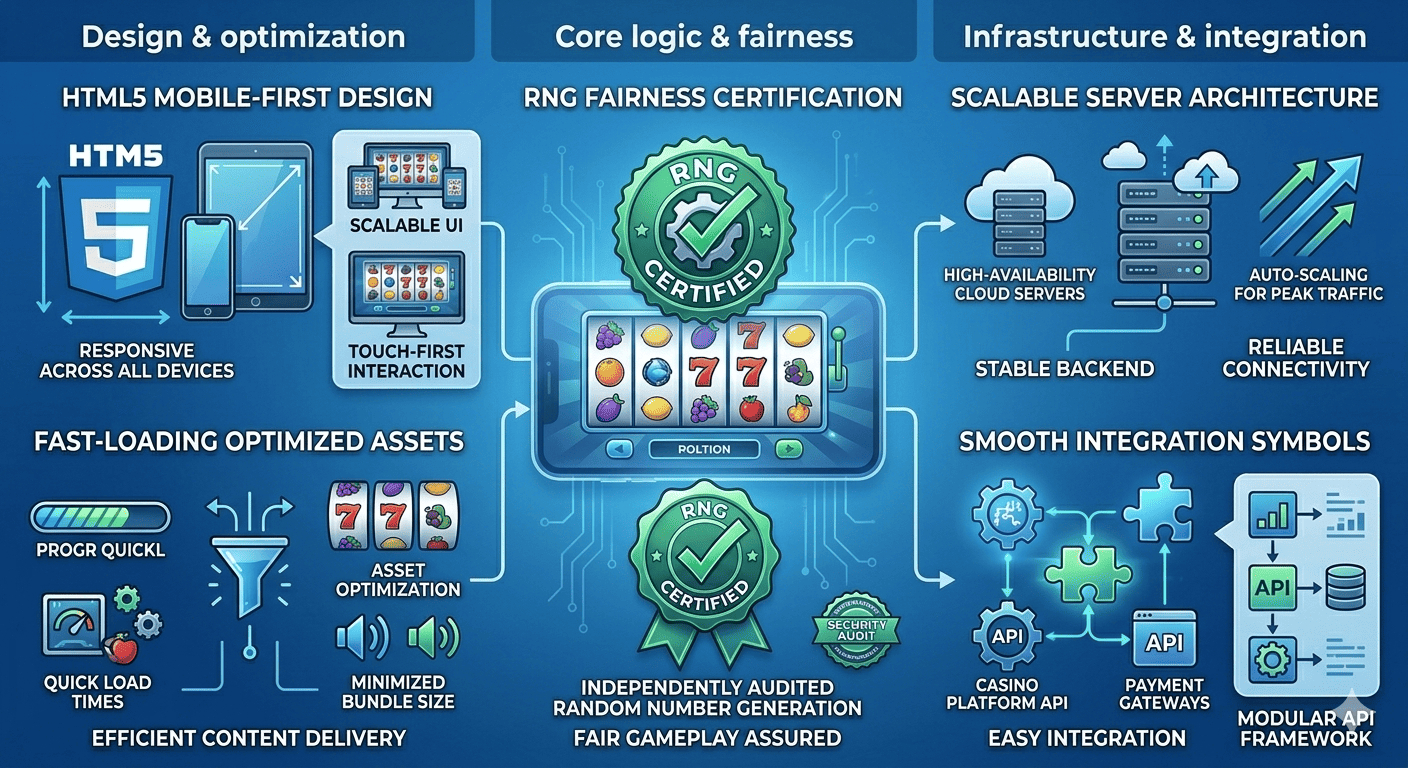
Engineering has two halves. The client is an HTML5 application rendering the reels, animations, and paytable, built for mid-range mobile hardware first — that is where most sessions happen. The server is the game logic on a Remote Game Server that draws outcomes server-side, enforces the certified math, and integrates with operator wallets through debit, credit, and rollback calls, plus promo APIs for free rounds and tournaments. QA runs continuously rather than at the end: functional testing of every feature, automated millions of spins comparing server output against the PAR sheet, and cross-device testing on real hardware.
Phase 5: Certification and Testing
Certification turns a finished game into a legally deployable one. The studio prepares the technical documentation package — math specification, source code review access, build reproducibility, RTP statements — and submits it to a laboratory such as GLI, eCOGRA, or iTech Labs for the target jurisdiction. The MGA, Curaçao, the UKGC, and other regulators each have their own requirements. The lab verifies that the RNG is fair, that live game behavior matches the submitted math, and that the RTP is within the declared bounds. Findings are fixed and re-tested; the clock is driven by the lab’s queue and by how clean the documentation is. This is why the math model was frozen back in phase 2: a logic change here restarts the process.
Phase 6: Launch and Live Ops
Release is a checklist, not an event: deployment to the operator platform or aggregator, jurisdiction configuration (RTP variants, language packs, restricted-territory handling), lobby assets and metadata, and a monitored rollout. After launch, live ops keeps the game earning:
- Tournaments and leaderboards configured per operator, driving repeat sessions around the base game.
- Free-round and free-spin campaigns targeted by the operator’s CRM through the promo API.
- Progressive jackpot linkage where the game supports pooled or standalone jackpots.
- Localization and market extensions: new languages, currency support, and jurisdiction-specific RTP variants.
- Performance monitoring — actual hold versus theoretical RTP, engagement funnels, crash telemetry — feeding a patch roadmap.
A game that ships without a live-ops plan plateaus within months. Studios that retain operators treat launch as the midpoint of the engagement, not the end.
The Deliverables Checklist
Before you sign, hold the studio to a concrete list. A complete custom slot engagement ends with:
- Game design document and final creative brief
- PAR sheet and math specification per jurisdiction
- Simulation report: RTP, volatility, hit frequency, maximum win
- Full art package with source files: symbols, backgrounds, animations, UI
- HTML5 game client and server-side game logic (RGS)
- Wallet integration and promo API support: free rounds, tournaments
- Certification report for each target jurisdiction
- Lobby and promotional assets, game metadata
- Post-launch support terms and handover documentation
Who Does the Work: Typical Team Roles
A slot title is produced by a small, specialized team. On compact engagements one person covers several rows; on a full custom title, all of these roles are active at some point:
| Role | Owns | Key Deliverables |
|---|---|---|
| Game designer / producer | Concept, feature set, coordination | GDD, creative brief, release plan |
| Mathematician | Game math | Paytables, reel strips, PAR sheet, simulation report |
| 2D/3D artist | Visual production | Symbols, backgrounds, characters, animation frames |
| UI/UX designer | Player-facing flows | Paytable screens, bet controls, mobile ergonomics |
| HTML5 developer | Game client | Reels and animation engine, sound hooks, cross-device build |
| Backend developer | Server and integration | RGS logic, wallet callbacks, promo and jackpot APIs |
| QA engineer | Quality | Functional suites, math verification spins, device matrix |
| Certification manager | Compliance | Lab submissions, documentation package, re-certification |
Frequently Asked Questions
How long does custom slot development take?
Several months from approved concept to certified release for a standard video slot. Art-heavy 3D production, novel math, or a long list of target jurisdictions each extend the timeline, and laboratory certification adds weeks determined by the lab’s queue.
What is the difference between custom slot development and a reskin?
Custom development produces new math, new art, and a new client. A reskin reuses a certified math model and game framework under a new theme — faster and cheaper, and often the right call for market extensions. Some jurisdictions still require a reskin to pass review, so confirm the target market’s rules before assuming certification can be skipped.
Can we commission a slot for a single market only?
Yes. The game is built and certified against that jurisdiction’s requirements: RTP disclosure, feature-buy restrictions, language, currency. Game certification is not an operator license, though — you either hold the license yourself (MGA, Curaçao, UKGC, and others) or launch through a platform partner who does.
Do we need a slot game developer or a full studio?
A lone slot game developer can build a client, but a real-money title needs mathematics, art, server-side game logic, QA, and certification management — a team, in other words. Studios sell that team as a service, which is why most operators outsource the full lifecycle instead of hiring piecemeal.
Gambling involves risk. Please play responsibly. This article is for informational purposes only.
EJAW provides end-to-end slot game development process — from math model and game art through certification and live ops. You can commission a complete title as a standalone project or hire slot game developers to reinforce an existing team. Send us your concept, target markets, and feature list, and we will map the phases, team, and timeline for your first release.