
How a $15 poker roguelike outsmarted the entire industry by hiding brutal exponential math behind a chill, lo-fi aesthetic — and what beginner devs can steal from it today.
⏱ 9 min read · 🎓 Beginner–Intermediate · 🛠 Unity · Unreal · Godot
It looks harmless. It is not. The design trap every dev falls into — and how one solo dev avoided it all.
Everyone Already Knows How to Play Balatro

Here’s the trick LocalThunk pulled on 50 million players: he didn’t teach them a new game. He handed them a game they already knew — Poker — and quietly bolted a nuclear reactor to the back of it.
The Core Loop of Balatro is scandalously simple. You play poker hands. You score points. You beat a blind. Repeat. There’s no tutorial wall, no 40-minute prologue, no lore dump. The entire onboarding happens in your brain before you even press start — because you’ve played Poker at a kitchen table, watched it on TV, or lost money on it at a family Christmas.
“The most powerful onboarding tool you’ll ever have is a mechanic the player already owns.”
This is the Shared Mental Model principle: when your game’s foundation exists in cultural memory, your barrier to entry collapses to near zero. You’re not teaching rules — you’re modifying them. That’s a fundamentally different cognitive load, and it’s the reason Balatro’s Steam page had a 90%+ wishlist-to-purchase conversion rate within its first week.
For beginner devs, this is lesson zero: don’t invent a game from scratch when you can remix one that already lives in your player’s head. Slay the Spire did it with card battles. Into the Breach did it with chess. Balatro did it with the most played card game on the planet.
The Synergy Math Behind the Curtain

150+ Jokers. ×10⁶ score scaling. ~0% tutorial text. 8 Antes to clear.
Then the Jokers arrive. And the game you thought you understood reveals its true face.
Balatro’s difficulty isn’t communicated through warnings. There is no “Warning: Level 5 is very hard.” Instead, the game employs Exponential Scaling — blind scores that multiply by roughly 1.5x to 2x per ante. Your score needs to go from 300 to 300,000 over eight stages. That’s not addition. That’s compound interest on your strategic mistakes.
The brilliance is in the Synergy Math. Each Joker has a simple, readable effect. “Add +4 Mult.” Fine. But three Jokers that interact — one multiplying Mult, one triggering on retriggers, one scaling off suits — create a Procedural Generation of power combinations that no single player will fully map in their first 50 hours.
“You don’t lose because the game cheated. You lose because you miscalculated an interaction three turns ago — and that feeling is addictive.”
This is the “good cheat” sensation. When a run collapses, the player’s gut reaction is “wait, that can’t be right” — but two seconds later they reverse-engineer exactly why it happened. The RNG in Balatro is generous enough to always give the player something to work with, but the interaction space is vast enough that most players are playing sub-optimally without realizing it. That gap between perceived skill and actual skill depth is the engine that drives 400-hour playtimes.
3 Technical Lessons for Beginner Devs

Lesson 1: The UI Is the Game
Balatro runs on a glorified spreadsheet. The “game engine” is mostly multiplications and additions. What makes it feel like fireworks is Juice — that umbrella term for the audiovisual feedback layer. Cards slam down with screen shake. Numbers count up with satisfying tick sounds. A hand evaluation triggers a cascade of animations that make simple arithmetic feel like a slot machine jackpot.
The takeaway for your Unity/Unreal/Godot project: your math can be boring as long as your feedback is not. Before you add a new mechanic, ask yourself — does the player feel this mechanic in their chest? If the answer is no, you don’t have a design problem. You have a Juice problem. Add the screen shake. Add the sound. Animate the number. Ship it.
Dev Tip: If you are building in Unity, spend 20% of your time on Tweening (using DOTween) and screen shake. It makes “boring” math feel like an explosion.
Lesson 2: Balancing the Unbalanced
Balatro is, on paper, completely unbalanced. Players regularly achieve scores of 100 million points by exploiting Joker synergies that the developer clearly did not intend as the “intended” path. And that’s fine. That’s the design.
The lesson here is the difference between breaking the game and destroying the game. Breaking it means the player found a powerful combo and felt like a genius. Destroying it means the player trivialized all challenge with zero effort. Balatro allows the former by keeping the difficulty curve steep regardless of how broken your build is — blind scores always scale up, and the game never lets you coast. Your job as a designer isn’t to prevent powerful builds. It’s to ensure powerful builds still require skill to construct and execute. Give players a rocket ship, but make them learn to fly it.
Dev Tip: Don’t fear the “Overpowered” build. Design your difficulty curve so that players have to find those broken synergies to survive. It creates a much more satisfying Core Loop.
Lesson 3: The MVP — Minimum Viable Product
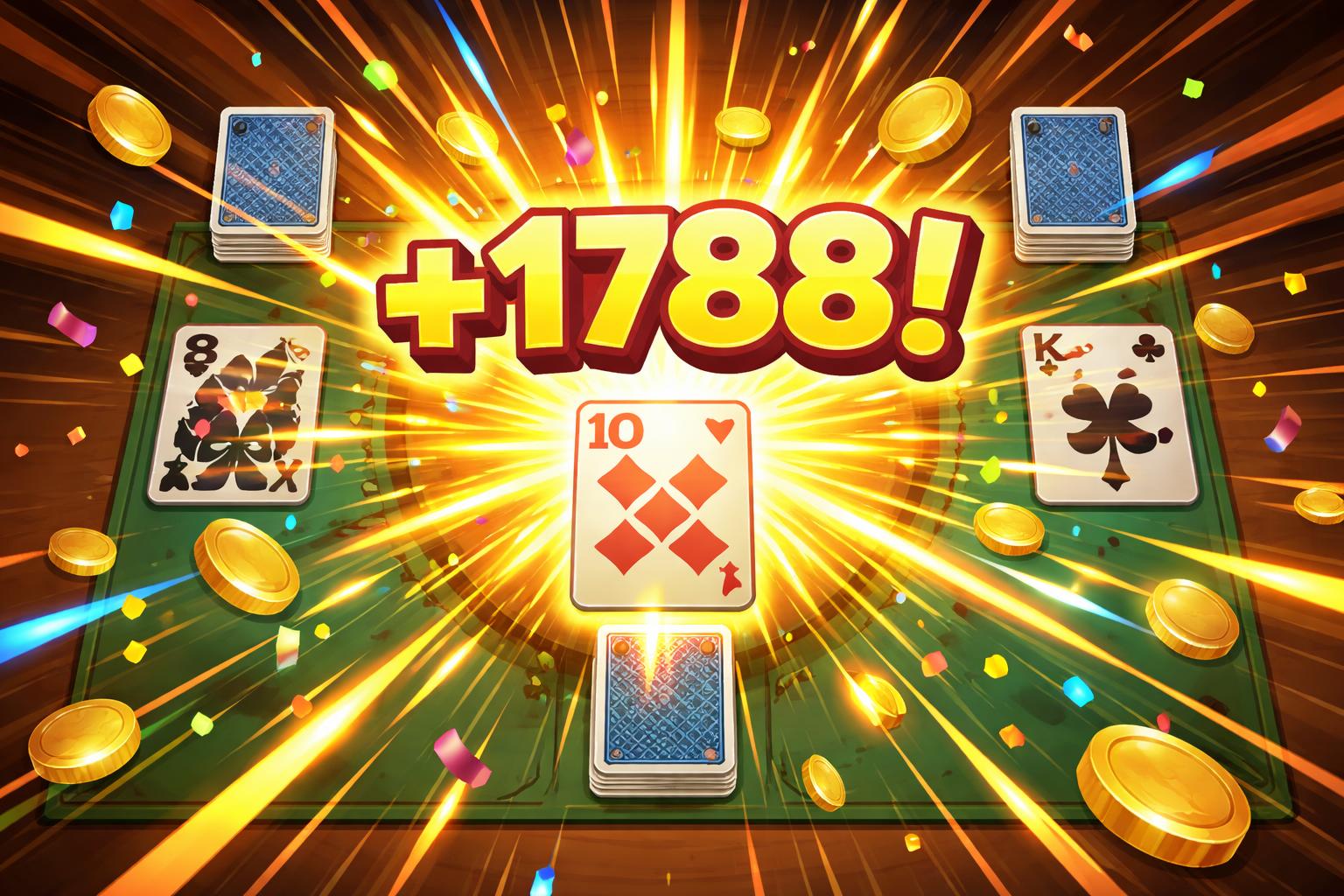
Balatro has no 3D assets. No physics simulation. No voice acting. No cutscenes. It has card sprites, a felt texture, and some very good particle effects. Its total file size is smaller than most AAA game trailers.
What it does have is a 10/10 difficulty loop: a core mechanic that is instantly understandable, a scaling system that creates endless variation, and feedback that makes every action feel consequential. This is the MVP principle applied to game design. Before you spend six months modeling a character, ask: does my core loop work with rectangles? If the answer is yes — ship the rectangles. Polish is not what makes players stay. Depth is what makes players stay. Balatro is a monument to that truth.
Dev Tip: Focus on your Systems. If your game is fun with white cubes and simple text, it will be legendary with art. Balatro is essentially a high-speed calculator with a beautiful CRT shader—and it made millions.
Balatro vs. Traditional Difficulty Design
| Design Element | Traditional Approach | Balatro’s Approach | Why It Works |
|---|---|---|---|
| Onboarding | Custom tutorial, new rules to learn | Borrows Poker — player already knows | Zero friction entry, instant engagement |
| Difficulty Signal | “Warning: Hard Level ahead” | Silent exponential score scaling | Player discovers the wall themselves |
| Complexity Delivery | Upfront rules dump | Joker synergies revealed over time | Curiosity loop stays open for 100+ hours |
| Failure Feeling | “The game beat me” | “I miscalculated — let me try again” | Blame shifts to player, not design |
| Balancing Philosophy | Patch out overpowered combos | Allow broken builds, keep scaling steep | Players feel genius, challenge remains |
| Visual Budget | High-fidelity assets expected | 2D sprites + particle juice | Depth over polish wins player retention |
| RNG Role | Random = unfair | Random = varied, always workable | Replayability without frustration |
| Core Loop Size | Complex, multi-system | One mechanic: play hand, score, repeat | Mastery feels achievable, depth is hidden |
Stop Over-Engineering. Start Balancing.
Balatro is not a technical marvel. It is a design marvel. It is proof that a single developer with a deep understanding of player psychology, reward loops, and exponential math can outperform studios with 10x the budget and 100x the headcount.
The formula, boiled down:
- Borrow a mental model your player already owns.
- Hide your complexity behind simple, readable rules.
- Scale your difficulty exponentially, not linearly.
- Juice your feedback until math feels like music.
- Allow players to break your game — just make sure breaking it is still hard.
You do not need Unreal Engine 5 nanite geometry to make a game that ruins someone’s sleep schedule. You need a tight Core Loop, honest RNG, and the discipline to cut everything that isn’t serving those two things.
Now it’s your turn.
What’s your “Low-Key Hard” game idea? The one that looks simple on the surface but hides something brutal underneath? Drop it in the comments, share this post with a dev friend who’s been over-engineering their project for the last six months, and let’s build something that doesn’t need a tutorial — because the player already knows how to play.
♠ Share this · ♥ Save it · ♦ Build something · ♣ Stop overthinking.