
You write an article with ChatGPT. You’re proud of it. Then you run it through Originality.ai and watch the “AI probability” bar slam to 98%. Your client sees it. Your editor flags it. Your SEO efforts tank before the page even indexes.
Here’s the thing — AI detectors have gotten ruthless. GPTZero, Winston AI, and Originality.ai no longer just look for robotic phrasing. They analyze sentence entropy, perplexity scores, and burstiness patterns. That’s why simply spinning synonyms through a basic paraphraser doesn’t cut it. The detector still feels the machine underneath.
What you actually need is a proper ai humanizer — a tool that restructures the rhythm of your writing, not just the words.
This guide cuts through the noise. We tested five tools, tortured their free tiers, and ran every output through three major detectors. Here’s what actually works.
What Makes a Good AI Humanizer Tool?
Before the list — let’s get one thing straight. A legit ai humanizer tool doesn’t just swap words. It should:
- Break up unnaturally uniform sentence lengths
- Introduce controlled “imperfections” (the kind humans actually write)
- Preserve your original meaning and tone
- Pass GPTZero, Originality.ai, and Winston without turning your prose into word salad
Most free tools fail on that last point. They’ll get you a “human” score but make your text sound like it was translated from Martian. Quality matters as much as the score.
The Top 5 Best Free AI Humanizers (Tested & Ranked)
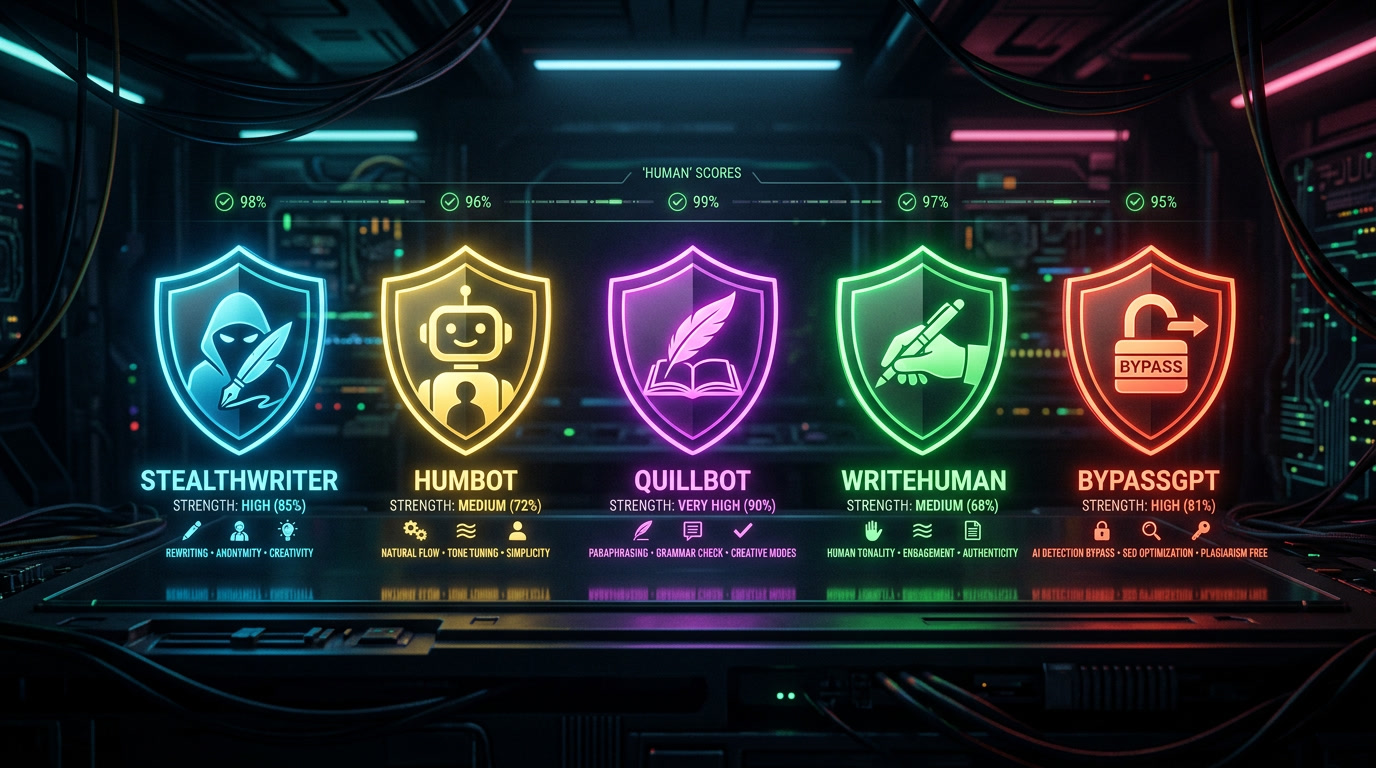
1. StealthWriter — The Specialist
The Vibe: StealthWriter is built specifically for one job: bypassing AI detectors. It shows. The output doesn’t feel like it went through a meat grinder. It feels like someone with a decent writing background cleaned up your draft over a lunch break.
Free Tier Limits: 300 words per run on the free plan. No daily cap on how many times you can run it, which is actually generous compared to competitors.
The Verdict: This is consistently the strongest performer on our radar. Passes Originality.ai roughly 80–85% of the time in testing. Where it struggles is long-form technical content — the humanization sometimes smooths out necessary precision. For marketing copy and blog posts? It’s the best humanizer in the free category, full stop.
2. Humbot — The Volume Player
The Vibe: Humbot leans into speed. Paste your text, hit the button, get results in seconds. The output reads a little flatter than StealthWriter — you can tell it’s optimizing for detection scores rather than readability. Think “passes the test” energy rather than “genuinely enjoyable to read.”
Free Tier Limits: 500 words per submission on the free tier. One of the more generous limits on this list.
The Verdict: Solid for bulk use cases where you need to process lots of content fast. Scores around 70–75% human on Winston AI. The trade-off is that some outputs need a light manual pass to sound natural again. Use Humbot as your first filter, then spend five minutes polishing.
3. QuillBot — The Safe Bet
The Vibe: You’ve heard of QuillBot. It’s not marketed as an ai text humanizer specifically — it’s a paraphrasing tool that happens to help with humanization as a side effect. The output quality is clean, coherent, and readable. It genuinely rewrites rather than just shuffles.
Free Tier Limits: 125 words per paraphrase on the free plan. That’s the tightest limit on this list, which makes it frustrating for longer content.
The Verdict: Here’s the honest answer — QuillBot doesn’t always pass aggressive detectors like Originality.ai on its own. It’s better at making AI text sound more human than it is at technically defeating detector algorithms. Use it as a finishing tool after a more specialized humanizer ai has done the heavy lifting. The combination is powerful.
4. WriteHuman — The Clean Output King
The Vibe: WriteHuman’s outputs feel the most natural of any tool on this list. There’s a lightness to the prose. Sentences vary in a way that actually mirrors how humans write — some long and flowing, some punchy. It doesn’t feel engineered.
Free Tier Limits: 200 words per run, limited to a handful of daily submissions on the free plan. The cap is real and annoying.
The Verdict: For short-form content — social posts, email copy, product descriptions — WriteHuman is arguably the best option here. The detection bypass rate is strong (consistently 75–85% human across detectors), but the word limit makes it impractical for long articles without a paid plan. If your budget allows, this one is worth upgrading.
5. BypassGPT — The Dark Horse
The Vibe: BypassGPT is direct about its purpose. It’s not trying to be a writing assistant — it’s trying to make AI text invisible to detectors. The outputs can occasionally feel a little mechanical in places, but the detection bypass performance is hard to argue with.
Free Tier Limits: Approximately 250–300 words per submission. The free plan is functional but limited.
The Verdict: BypassGPT punches above its weight on GPTZero specifically — one of the harder detectors to fool. If GPTZero is your main concern (common in academic and editorial contexts), this is your tool. For Originality.ai, results are more variable. It’s a strong secondary option to pair with your primary text humanizer of choice.
Quick Comparison: All 5 Tools at a Glance
| Tool | Free Word Limit | Avg. Human Score (%) | Best For |
|---|---|---|---|
| StealthWriter | ~300 words/run | 80–85% | Blog posts, marketing copy |
| Humbot | ~500 words/run | 70–75% | Bulk content processing |
| QuillBot | ~125 words/run | 60–70% | Finishing and polishing |
| WriteHuman | ~200 words/run | 75–85% | Short-form content |
| BypassGPT | ~250–300 words/run | 75–80% | GPTZero-heavy environments |
Scores based on testing across Originality.ai, GPTZero, and Winston AI. Results vary by content type and topic.
The Pro-Tip Section: How to Hit 100% Human Without Paying for Premium

No tool gets you to 100% every time on every detector. That’s the truth they don’t put in the landing page copy. But here’s how you close the gap manually.
1. Break the pattern at the start. AI almost always opens paragraphs with a topic sentence, then supports it. Flip this sometimes. Start with a detail or an example, then land the point. Detectors pick up on the uniformity.
2. Add one “throwaway” sentence per section. Real humans meander slightly. A sentence that’s a bit tangential — a quick aside, a rhetorical question, a minor observation — breaks the statistical signature of AI text. One per section is enough.
3. Vary your sentence lengths aggressively. Go from 22 words to 5 words to 14 words. AI text clusters around similar sentence lengths. Human text doesn’t. This single habit moves your score more than almost anything else.
4. Use contractions strategically. Not everywhere — that becomes its own pattern. But “it’s,” “don’t,” “you’re,” and “they’ve” scattered naturally throughout the text add a human fingerprint that detectors recognize.
5. Read it out loud before publishing. If you stumble on a sentence, rewrite it. Awkward-to-speak prose is often exactly what flags AI detectors. If your mouth trips on it, the algorithm probably notices it too.
6. Change at least one “AI-favorite” word per paragraph. Words like “crucial,” “ensure,” “comprehensive,” “streamline,” and “leverage” are statistical red flags. Replace them with plain, direct language. Say “key” instead of “crucial.” Say “make sure” instead of “ensure.” Small swaps, big impact.
Final Word
The gap between “AI-generated” and “human-written” is closing fast — but it’s not closed yet. The tools above are the best free options available right now for getting your content across the line. StealthWriter and WriteHuman lead the pack for quality. Humbot wins on volume. BypassGPT is your specialist weapon for GPTZero.
None of them replace the manual polish step. Think of a best free ai humanizer as doing 80% of the work for you. Your job is the last 20% — the part that makes the text actually worth reading, not just worth publishing.
That’s the combination that wins: smart tooling plus a human who still gives a damn about the writing.