
Creating extremely responsive designs today is more of a norm than a trend. A number of other factors contribute to user experience, including ease of use, appeal, discoverability, simplicity, and, most importantly, the ability to evoke emotions toward a product or service.
There’s always scope to add a “fun” element to the UX and make it more enjoyable. The notion of immersive design using AR and VR is currently a trend, and gamification can enrich the experience by introducing game-like elements. It builds a culture of development and achievement and a culture of competition that propels the business mission.
Gamification can be a powerful way to retain users, encourage learning and development, and generate excitement and interest. Thus, many enterprises reap the benefits of this technique, motivating their employees to perform better and their customers to stay engaged with their products and services.
Let’s delve into the details of this exciting UX design method and how it could benefit your organization.
What is Gamification?
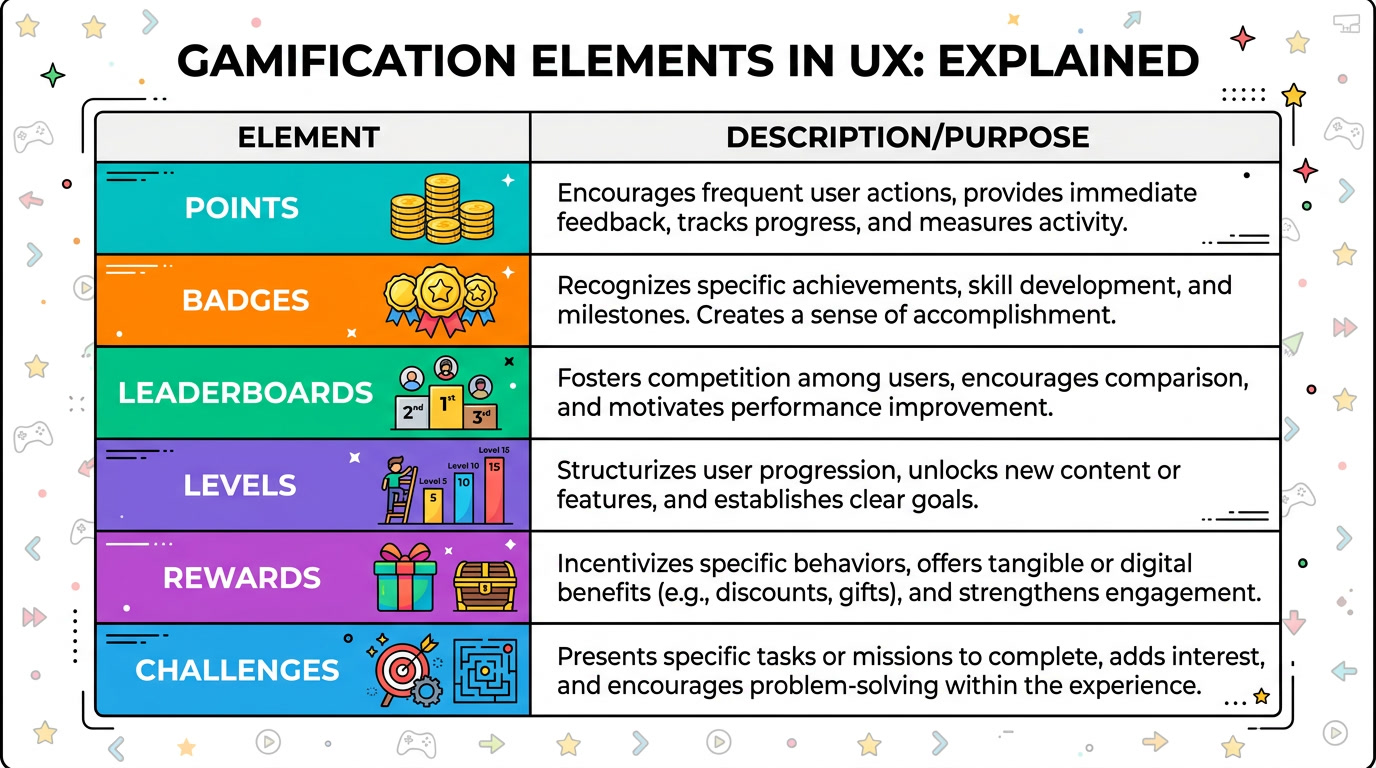
| Gamification Element | Description | Purpose in UX |
| Points | Users earn numerical rewards for actions | Encourages continuous interaction |
| Badges | Visual achievements for completing tasks | Builds motivation and recognition |
| Leaderboards | Ranking system among users | Creates competition and engagement |
| Levels | Progress stages based on activity | Gives users a sense of growth |
| Rewards | Incentives like discounts or perks | Increases retention and loyalty |
| Challenges | Tasks with goals and rules | Drives active participation |
It uses game mechanics in non-game/productive tasks or in the real world, like web pages and mobile apps. Gamification design is his or her focus, as it is human-oriented compared to functional design. The new feature will improve user interaction with the interface by adding engaging features such as leaderboards, badges, and jackpot points within an existing system.
Other companies allow their clients or employees to cash in their points or receive benefits based on the points they have earned. In gamification, designers exploit users’ intrinsic motivation so they will like the process more.
The Appeal of Gamification in UX Design
Gamification is fun because it appeals to these eight core drives that motivate us towards certain activities. UX designers need to take these drives into account when creating a gamification-driven application or webpage.
Gamification is closely linked with online engagement strategies in digital platforms, helping businesses improve user interaction and retention. The key psychological concept of gamification is to ensure that we reinforce every action we take positively. It is being taken seriously by many organizations due to the following reasons:
- Gamification brings immediacy and relevance to users within an application or site.
- It motivates users to achieve the objectives and overcomes negative perceptions of the system.
- Users complete tasks they would not otherwise accomplish because they are motivated by rewards.
- It is possible to use several methods such as gameplay, mapping of rules to goals, countdowns, rewards on completion of some percentage or level of tasks, etc.
- Interactions make people more familiar with a design to address issues.
- Gamification involves learning and sharing of knowledge in a more entertaining manner.
- Social factors and connections with social media enable users to share their experiences in the digital universe.
Benefits of Gamification for UX Designers
- They can make their designs interesting and interactive, as well as increase user interest.
- Gamification enhances knowledge acquisition and retention on a learning site.
- Gamification helps reveal specific player behaviors and learning experiences as feedback, enhancing design features and performance in a test environment.
- They can enhance the explorability of a site’s various functions through fun elements and by motivating curiosity.
| Category | Benefits |
| Users | Higher engagement & retention |
| Employees | Better productivity & teamwork |
| Businesses | Increased loyalty & revenue |
| UX Designers | Improved user insights |
| Learning Platforms | Faster learning & retention |
Benefits of Gamification for Employees (through In-house Apps)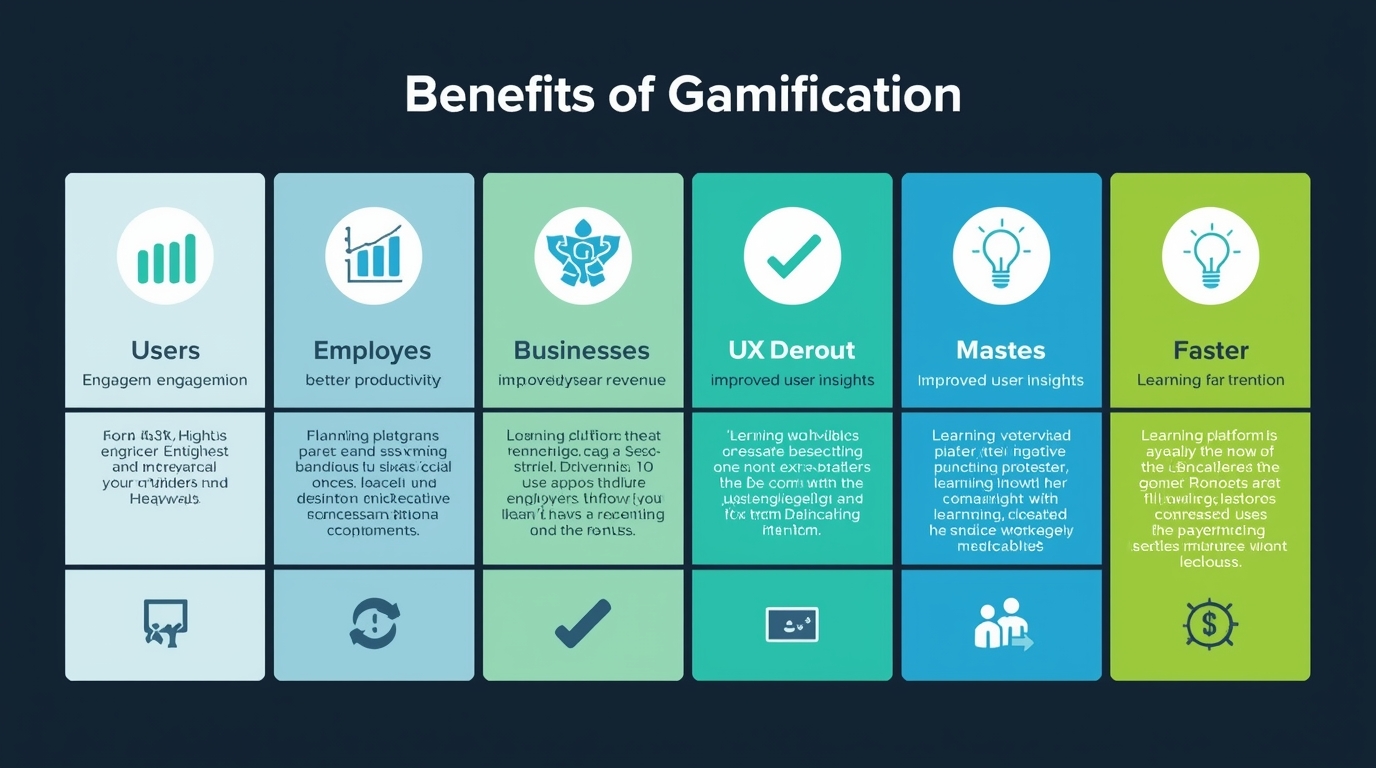
Employees Motivation
Gamification is employed to foster a healthy competitive environment that enhances employee performance. Competitions in a game will be regarded as fun and less significant than failure in work. It also enhances employees’ work spirit.
Cost Reduction
Gamification is an effort by many companies to cut costs by training their current workforce in the skills needed (such as programming or team management) through it.
Accelerate Productivity
Performance is a way that incentivizing efforts are important in improving productivity. The employee may be motivated by rewards such as pay bonuses, or paid leave, or awards to continue running the engine.
Reduce Stress
The introduction of stress reduction through a fun UX design of a gamification activity can lead to improved performance and increased employee outputs that are more important.
Fast Staff Training
Workers will learn more quickly and easily when the course is enjoyable and has a reward at the end. With a reward attached to it, they are able to complete the training much faster with a better understanding.
Benefits of Gamification for Businesses
Important Design Principles of Gamification
The principles of gamification are as follows, and a lot of gamification does not lie in the regulations but the implementation. Linguistic and helpful information structure is essential in ensuring a user is confident, not a list of ideas and mechanics.
Challenge Users
This is mainly done by inviting a user to a tough competition. The player should be provided with an easy task (challenge) in the application with clear rules, conditions, and fulfillment terms with the highest transparency level. If they appear too complex, users will stop immediately. Some tips include:
- Giving the users perfect and appropriate cues and chances to challenge themselves.
- Displaying visuals that promote a user’s urge to win and compete.
- Giving users the opportunity to display their earnings to others encourages other users to improve their performance and compete.
Support Falling Forward
Users should be motivated to keep trying, playing, and engaging in the gamification system you are developing through motivational cues and messages. This also involves insisting on providing the user with an option to resume (go back to your app) through push notifications, reminders, or even alerts.
Encourage Consistency
Motivate users whenever they lose and suggest that the only way to win is to be consistent. Whether a team wins or loses, it is very important always to uplift the players so that they are excited and motivated to go on. Constant and cozy wording and text is essential in order to show users are achieving progress.
Give a Fulfilling and Thrilling Experience
The gamification experience should be invigorating and enticing. Rewards provide a logical conclusion to the whole process. The reward’s attractiveness should elicit a sense of pleasure, fun, and thrill.
Moreover, other UX design features, such as color, animations, iconography, and customizations, will evoke excitement and provide a unique atmosphere for players with certain achievements. This could be implemented by having analytics that create animations, eye-catching icons, and objects that rise and move in response.
Personalization and Ownership
Individualized content and design create a feeling of pride and ownership among the users. Delivering a customized experience to users based on their tastes, and one that they can customize themselves, is a crucial feature of gamification design.
It meets all other gamification principles and lets players own the application in the most relaxed way. Add an option to choose what they want their avatars or profile pictures to be, customize their interface with colors or styles for onscreen objects, and be rewarded with achievements for doing so.
These are some hacks you can employ to make your app highly interactive with gamification.
- Virtual money. Although it is only virtual, people are motivated to perform tasks to earn it. It is the best tool for encouragement, if not a reward.
- Reminders can be delivered via an app or a challenge as push notifications, providing the player with the necessary information about performance, timelines, competition, and so on.
- Status indicates the different player or performance levels. Users like to receive a new status, particularly when they are competing toward an objective.
- Tips. To find the workflow of the gamification platform, new players can use tips. They make the experience and navigation of a site/application easier.
Wrapping up
An effective UX design encompasses greater user interaction via an enjoyable experience and fulfilling the primary intention of the design. Gamification is not something you should add as a feature, nor should you suddenly incorporate it into your design.
It is useful not only for users but also for employees and organizations, as it enhances productivity and learning. When used effectively, gamification can turn a user-friendly interface into a rich experience that fosters sustained interaction and business growth, keeping users engaged and motivated.