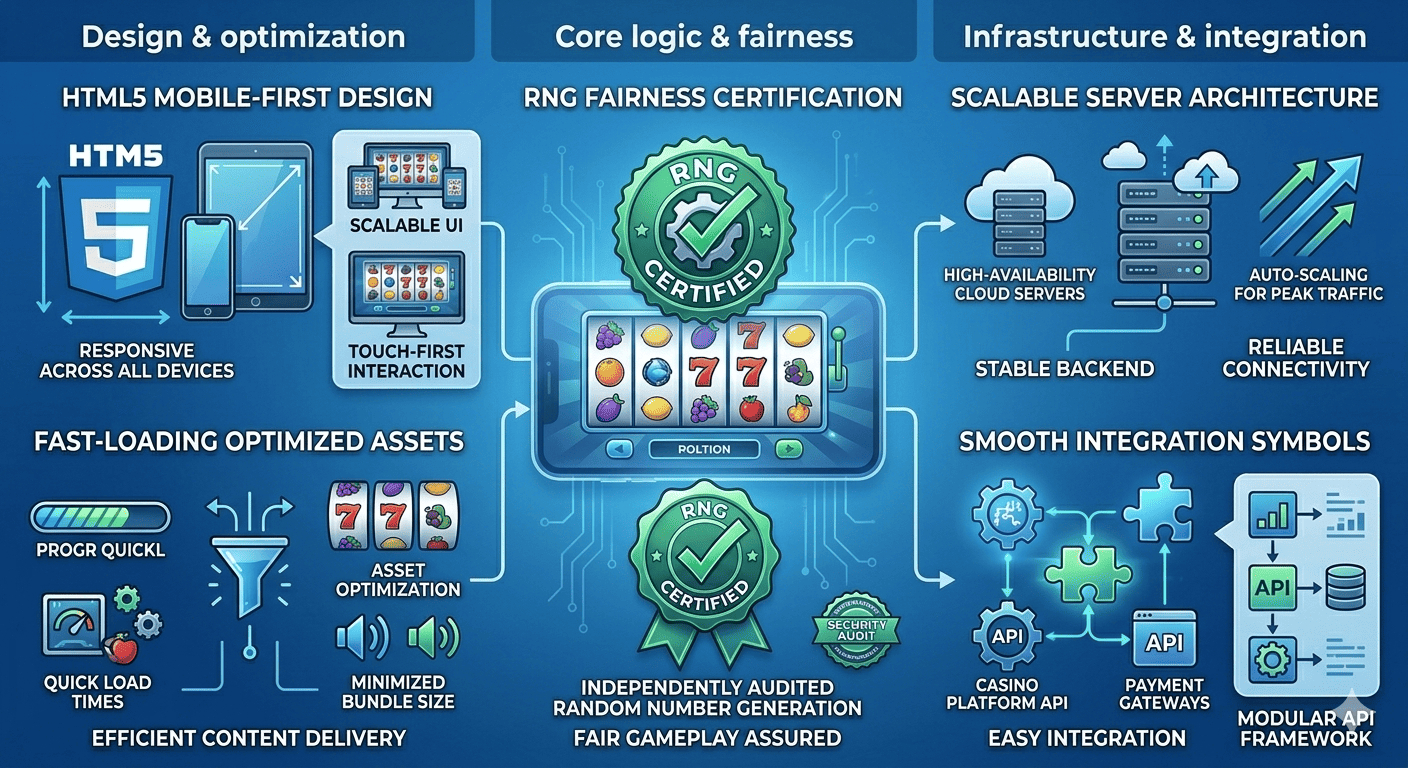

Choosing a slot machine provider is one of the highest-leverage decisions an online casino makes. Slots typically account for the majority of GGR in most lobbies, and the provider you sign with determines not just which games your players see, but your release cadence, your integration risk, your compliance posture and your negotiating position for years. Yet the market is confusing by design: “provider”, “studio”, “developer”, “aggregator” and “supplier” are used interchangeably by companies whose actual roles differ significantly. This guide clarifies what a slot machine provider actually does, how the models differ, and how to evaluate candidates on criteria that predict performance rather than marketing.
What a Slot Machine Provider Does
A slot machine provider develops slot games and delivers them to operators in a playable, compliant, revenue-generating form. In practice that covers a chain of responsibilities:
- Game development — concept, art, animation, sound, math modelling (RTP, volatility, hit frequency, feature design) and the HTML5 game client itself.
- RGS (Remote Game Server) — the server-side engine that holds the certified math, executes every spin server-side, settles bets and wins against the operator’s wallet, and exposes the integration API. This is the load-bearing part of the business: the RGS is what makes a game a product rather than a demo.
- Certification and compliance — lab testing of the RNG and game logic (GLI, BMM, iTech Labs), market-specific builds, RTP disclosure and jurisdiction documentation for each regulated territory the games ship to.
- Integration and distribution — connecting to operator platforms directly or via aggregators, plus ongoing API maintenance, release management and technical support.
- Content pipeline — a release calendar of new titles, because lobbies live on freshness; providers differ enormously in how reliably they ship.
When you sign with a provider, you are buying this whole chain — and the quality of the weakest link in it, not the quality of their best game, is what your players will experience.
Providers vs Studios vs Aggregators
The three roles overlap in marketing language and differ in substance. A studio is a development company: it makes games but may not operate an RGS, hold certifications or distribute at scale — studios often license their content through someone else’s infrastructure. A provider (in the full sense) owns development plus RGS plus certification and distributes games to operators as a service. An aggregator develops nothing (usually): it aggregates hundreds of providers’ games behind one integration API, so an operator connects once and gets a whole catalogue — the trade-off is a margin layer and another party between you and the game maker.
| Dimension | Slot provider | Game studio | Aggregator |
|---|---|---|---|
| Core business | Develops slots and supplies them as a certified, integrated product | Develops games (own IP or work-for-hire); may not handle distribution | Distribution platform; resells many providers’ content via one API |
| Owns RGS | Yes — typically | Sometimes; often uses a third-party or partner RGS | No — routes to provider RGS |
| Certification | Holds certificates for its games per market | Variable; may rely on the RGS owner’s certification | None of its own; inherits providers’ certificates |
| Integration count | One integration gets one catalogue | One integration gets one studio’s games | One integration gets hundreds of studios |
| Commercial terms | Revenue share or flat fee directly with the developer | Often cheaper; licensing via provider adds margin | Extra margin layer; simpler operations |
| Best fit | Operators building a long-term content relationship | Operators wanting unique content at lower cost, accepting integration overhead | Operators prioritising breadth and fast launch |
For a startup casino, an aggregator-first strategy is rational: breadth fast, one contract. For an operator at scale, direct provider relationships — negotiated revenue share, custom features, exclusive windows — become the more economical and strategic path. Most mature lobbies end up with a mix: aggregators for long-tail breadth, direct provider contracts for the content that drives retention.
How to Evaluate a Slot Machine Provider
Evaluate candidates against the criteria that actually correlate with lobby performance:
- Portfolio quality and depth — not the number of titles but the number that hold retention in comparable lobbies. Play their games on real operator sites, on mobile, at real stakes. Check release cadence history over the past two years: a provider shipping 6–12 solid titles a year beats one that shipped 40 games in 2021 and four since.
- Math quality — RTP and volatility discipline, feature innovation, and transparency: can they produce certified math reports, simulation evidence and configurable RTP versions per market? Weak math is invisible in a demo and expensive after launch.
- Certification footprint — which jurisdictions their games are certified in today, and how fast they certify new ones. If your roadmap includes MGA markets or newly regulated regions, ask for the certificate list, not the intention.
- RGS robustness — uptime record, API documentation quality, latency, wallet reconciliation accuracy and incident response. The RGS is where your revenue settles; ask for uptime numbers and integration references from operators of your size.
- Integration and platform fit — support for your platform or aggregator, sandbox availability, time-to-live after signature, and whether back-office tooling (game config, promos, free rounds, tournaments) is included.
- Commercial terms — revenue share structure, minimum guarantees, exclusivity options, marketing support and whether bespoke or branded games are on the menu as the relationship matures.
Run the same checklist across every candidate and score it before conversations drift into relationship terms. Providers that resist basic diligence — live-game access, certificate lists, reference calls — have already told you something.
If your strategy includes owning content rather than only licensing it, the evaluation changes shape: you are then choosing a development partner rather than a supplier. That is a different conversation — one where the partner’s math team, art capacity and certification track record matter more than their existing catalogue — and it is worth reading how a casino game development engagement is scoped before entering it. Teams that plan to internalise production over time can also hire slot game developers as an embedded extension rather than a black-box vendor, keeping the roadmap and the math IP on their side of the table.
Frequently Asked Questions
What is the difference between a slot provider and a slot developer?
In practice, “developer” and “studio” emphasise the making of games, while “provider” implies the full supply chain — development plus RGS, certification and distribution to operators. Some companies are both; some studios distribute through providers; the distinction is in what they operate, not in job titles.
Do I need an aggregator if I already have direct providers?
Most large lobbies use both. Direct provider contracts give better economics and strategic control over your top content; an aggregator adds breadth cheaply with a single integration. The tipping point is usually catalogue size versus margin sensitivity.
How long does provider integration take?
Direct provider integrations typically run 2–6 weeks including sandbox testing and certification checks on your markets; aggregator integrations are often faster per game but add a contractual and margin layer. Ask candidates for their historical time-to-live after contract, in writing.
What revenue share do slot providers charge?
Market norms hover around 10–25% of GGR on the provider’s games depending on volume, exclusivity and market; aggregators take an additional cut. Flat-fee and hybrid models exist for bespoke content. Terms scale sharply with the GGR you commit, which is why consolidation onto fewer, stronger providers pays.
Can a provider build a custom or branded slot for my casino?
Many full-stack providers and studios do bespoke work, from branded reskins of existing math to fully original titles. If a custom game line is your goal, evaluate development capability directly — portfolio of bespoke work, math team depth, art capacity and certification support — rather than their off-the-shelf catalogue.
Gambling disclaimer: this article is intended for business professionals in the iGaming industry and covers supplier selection and game development topics. It is not gambling advice. Online gambling involves financial risk; operators must hold valid licences in their jurisdictions and comply with applicable regulations and responsible-gaming standards.