
Few verticals in online gambling have grown as fast as crash games. The format is simple — a multiplier climbs from 1.00x upward, and the player must cash out before it crashes — yet it consistently produces some of the highest session engagement in the industry, particularly among crypto-facing audiences. For operators and studios weighing whether to add a crash title to their portfolio, the questions are practical: how do crash casino games actually work under the hood, what does the development stack look like, what does certification involve, and what should a realistic budget be? This guide answers all four, from mechanics and provable fairness to launch and cost.
What Crash Games Are
A crash gambling game is a real-time betting format built around one continuously rising number. A round opens with a short betting window, the multiplier then starts climbing from 1.00x, and at a cryptographically predetermined moment the game “crashes” — the round ends and every player who has not cashed out loses their stake. Players who cash out before the crash receive their stake multiplied by the value on screen at that instant.
The appeal is psychological and mathematical at once: the player controls the exit, the outcome unfolds in real time alongside other players’ cash-outs, and rounds are short — often 10 to 30 seconds. The format emerged in crypto-first casinos around 2019 and has since been adopted by mainstream aggregators and tier-one operators as a lobby staple. Crash games are no longer a niche; they are a category most modern casino lobbies are expected to carry.
How Crash Mechanics Work
Underneath the animated curve, a crash game is a deterministic random draw dressed in real-time theatre. A production-grade implementation typically works like this:
- Server seed generation — before play, the server generates a secret seed (or a chain of hashes derived from one) that will determine crash points for future rounds. The hash of this seed is published in advance.
- Client seed contribution — in fully provably fair implementations, the player’s own client seed is mixed in, so neither party alone can predetermine the result.
- Crash point calculation — for each round, a cryptographic hash of the combined seeds is converted into a number on a known distribution: most rounds crash at modest multipliers, with a small probability of very high ones and a fixed instant-bust probability.
- Reveal and verification — after the round (or after the seed is rotated), the server seed is revealed, letting any player recompute the hash and confirm the crash point was fixed before bets closed.
Two details separate amateur builds from certified ones. First, the house edge is embedded in the crash-point distribution, not deducted post-hoc: a common design applies a 1% edge so RTP lands at 99% in a provably fair model — or a configurable 96–97% in markets requiring specific RTP disclosure. Second, the round loop must be server-authoritative: the client renders the curve, but cash-out acceptance, timing and settlement happen server-side with latency compensation, or the game is both cheatable and uncertifiable.
Why Operators Choose Crash Games
The commercial case for adding crash games rests on several measurable advantages:
- Exceptional engagement — short rounds, visible live wins and social layers (bet lists, leaderboards, in-game chat) produce session lengths and bet frequency well above traditional slots.
- Crypto-friendly DNA — the format grew up on crypto casinos, so audiences already expect provably fair verification and instant crypto settlements; it converts crypto traffic efficiently.
- Low content cost per session — a single well-built crash game carries an entire lobby section for years, unlike slots that need a steady release cadence.
- Simple rules, broad audience — there is no paytable to learn, which lowers the entry barrier for casual players and works across languages without heavy localisation.
- Cross-sell surface — crash rounds fit naturally with live-win feeds, missions and cashback mechanics, amplifying retention tooling you already run.
The flip side deserves equal attention: crash games concentrate risk in short bursts, so responsible-gaming tooling (loss limits, session reminders, self-exclusion) must be first-class features, not bolt-ons — regulators increasingly expect it, and certification bodies test it.
The Development Stack
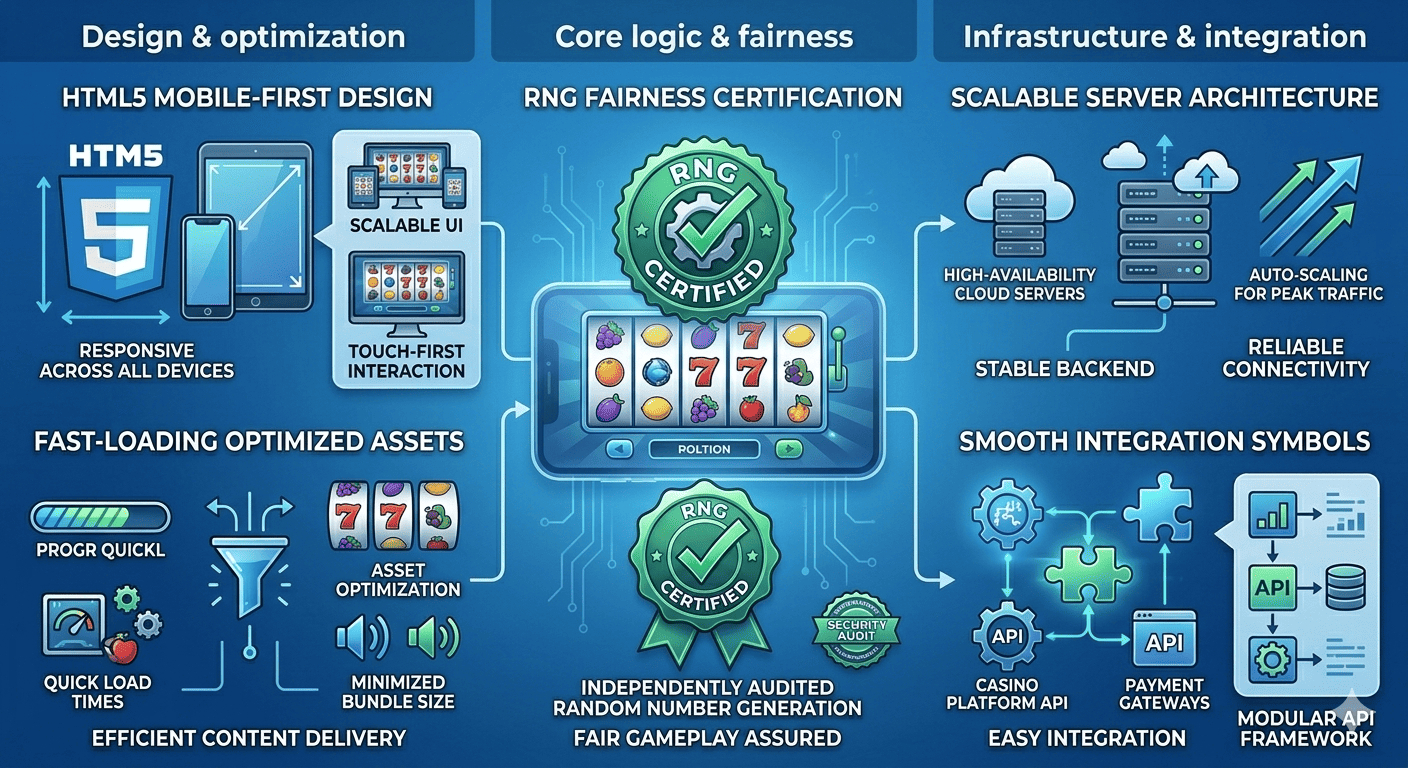
A production crash game is a real-time systems project more than a graphics project. The core stack that most serious studios converge on:
| Layer | Typical choice | Why it matters |
|---|---|---|
| Game client | HTML5 / WebGL (Canvas or PixiJS), responsive portrait + landscape | Crash traffic is overwhelmingly mobile; the curve animation must stay smooth at 60 fps on mid-range phones |
| Real-time transport | WebSocket (or WSS) with a load-balanced stateful server | Multiplier ticks, bet lists and cash-out events must reach hundreds of concurrent players with sub-second latency |
| Game logic server | Node.js, Go or Elixir handling round loop, bets, cash-outs, settlement | Server-authoritative logic prevents client-side manipulation and survives node failover |
| Provably fair engine | HMAC-SHA256 seed chains, hash publication, verifier page or widget | The fairness model is the product; it must be independently verifiable and auditable |
| Wallet & ledger | Integration layer to the operator’s wallet, casino platform or RGS API | Bets and wins settle in real time against balances, including crypto wallets; the ledger must be exact |
| Back office | Admin panel for RTP config, round history, risk and bonus tooling | Operators need live control over edge parameters, limits and promotional features |
Two engineering challenges dominate the budget. The first is stateful real-time scaling: unlike slots, where each spin is an independent request, a crash round is shared state across all concurrent players, so architecture must handle sticky sessions, failover mid-round and idempotent settlement. The second is fairness engineering: the provably fair scheme must be designed so that it can be certified, explained on a public page and verified by third-party tools — this is what separates a credible crash product from a screenshot of one.
How to Launch a Crash Game
A launch sequence for an operator commissioning a crash title runs through six stages:
- Specification and math sign-off — define the crash-point distribution, target RTP, house edge, auto-cash-out behaviour, limits and market set; freeze the math model before any UI work.
- Development — build the game server, real-time layer, HTML5 client, wallet integration and back office; typically 8–14 weeks depending on scope.
- Internal QA and load testing — simulate thousands of concurrent players; verify settlement correctness under failure conditions (network drops, node restarts mid-round).
- Certification — submit to an accredited lab (GLI, BMM, iTech Labs or a jurisdiction-specific body). The lab validates the RNG/fairness scheme, game logic, RTP and RG features; budget 4–8 weeks including fixes.
- Integration — connect via RGS/API to the operator platform or aggregator, pass integration QA, and run parallel settlements in a staging wallet before going live.
- Soft launch and hardening — limited-audience release, live monitoring of latency and settlement logs, then full rollout with promotional support.
Timelines compress when the studio already owns a certified crash engine; a first-time build with new math and new infrastructure is the slow path. If your team lacks in-house real-time and gambling-certification experience, partnering with an experienced casino game development studio is usually faster than learning certification through lab feedback cycles.
Crash Game Cost
So what does a crash casino game cost? For a custom build, expect €15,000–20,000 at a typical studio as the realistic entry point for a production-quality, certification-ready title. That range covers a full HTML5 client, server-authoritative round logic, a provably fair engine, wallet integration and back-office basics, scoped as a single game with a standard feature set. The range below it (€8–12k) generally means significant reuse of an existing certified engine or a reduced feature set; above it (€25k+) buys custom branding, gamification layers, multi-market compliance builds and deeper platform integrations. Treat any quote far below the range with suspicion — the usual omissions are server-authoritative logic, provable fairness documentation and certification support, and retrofitting those later costs more than building them in.
Three cost drivers push a quote from one end to the other: integration scope (a proprietary platform API takes longer than standard RGS), certification market count (each additional jurisdiction adds lab fees and rework), and custom art direction.
For teams that want crash mechanics without a ground-up build, hybrid approaches exist: white-labeling a certified engine or licensing math for re-skinning. But if crash games are meant to become a product line rather than a one-off, commissioning a custom title — or choosing to hire slot game developers with real-time gambling experience to extend your own roadmap — is the more defensible investment.
Frequently Asked Questions
How long does it take to develop a crash game?
Typically 3–5 months from signed spec to certified release: 8–14 weeks of development, 4–8 weeks of certification and integration, overlapping in practice. Builds that reuse an existing certified engine cut this roughly in half.
Are crash games provably fair?
A properly built one is. The crash point for each round is derived from a hash chain published in advance, optionally mixed with the player’s client seed, and the server seed is revealed after rotation so any player can verify past rounds. Certification by an accredited lab validates the scheme independently.
What RTP do crash games have?
Provably fair crash games commonly run at 99% RTP (a 1% house edge) embedded directly in the crash-point distribution. Regulated markets may require a different disclosed figure — typically 96–97% — which is a configuration decision, not an algorithm change.
Can a crash game be integrated into an existing casino platform?
Yes, via standard RGS-style APIs: wallet debits/credits, round events and settlement callbacks. The heavier part of integration is usually the real-time layer — shared rounds mean your platform must handle live bet streams and latency-tolerant cash-outs gracefully.
Do crash games work with crypto payments?
They are the format’s native habitat. Crypto wallets settle instantly, which matches the round cadence, and crypto audiences expect the provably fair verification that crash games were built around. Fiat integrations work identically through the same wallet layer.
Gambling disclaimer: this article is intended for industry professionals (operators, studios and platform teams) and describes game development and certification processes. It is not gambling advice. Online gambling involves financial risk; operators must hold valid licences in their target jurisdictions and comply with local regulations and responsible-gaming requirements.
Curious about the mechanics behind the multiplier? Read how crash games work: mechanics and fairness explained.