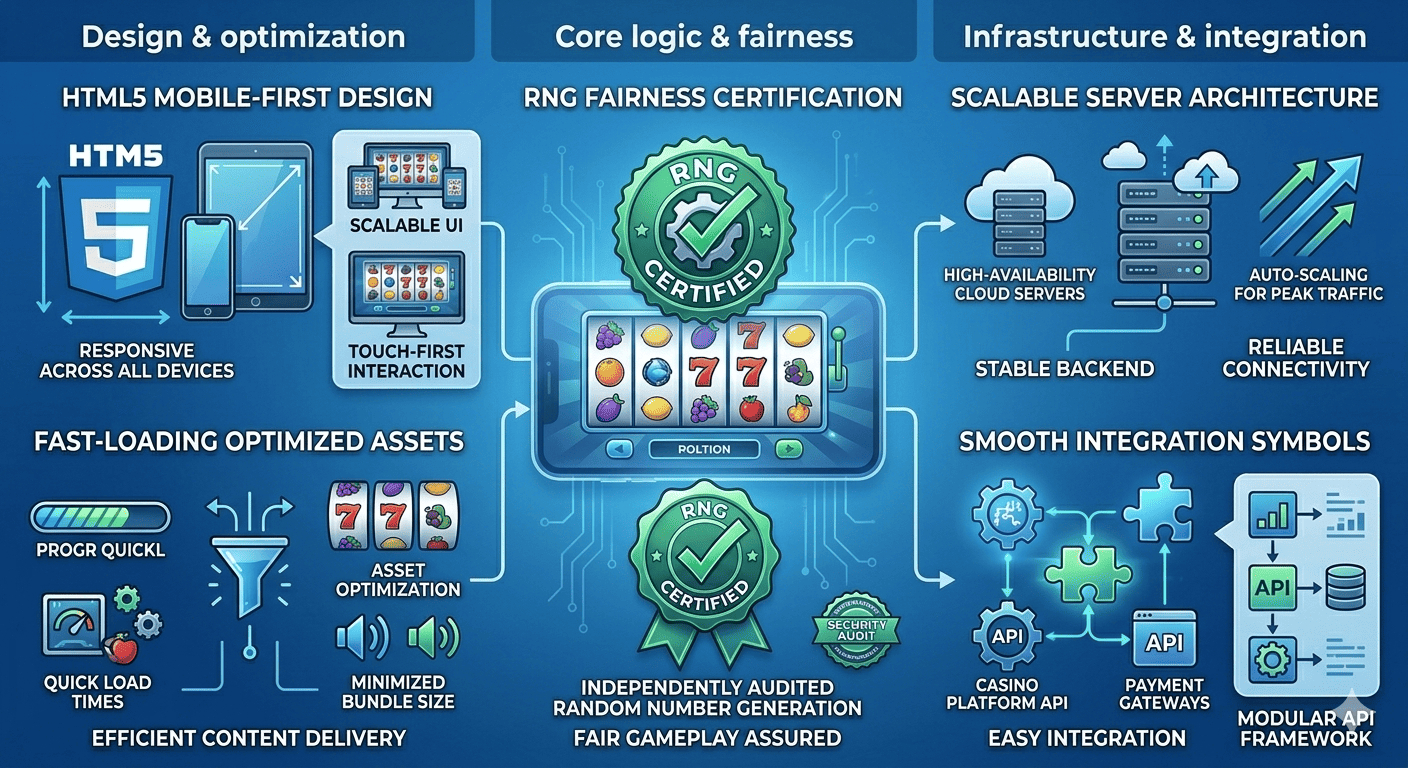

Crypto casinos are no longer a fringe segment. What started as Bitcoin-accepting clones of classic lobbies has matured into a distinct product category with its own audience expectations: verifiable fairness, instant on-chain or off-chain settlements, and games designed for a wallet-first user journey. Building for that category is not the same as building conventional casino games with a crypto payment plugin bolted on. This guide explains what crypto casino games actually involve, why choosing specialised crypto casino game developers matters, and which criteria should drive your studio selection.
Crypto Casino Games Explained
A crypto casino game combines three layers that traditional games handle differently:
- Provable fairness — instead of asking players to trust a certified-but-hidden RNG, crypto-native games expose the randomness itself: the operator publishes a hashed server seed before play, the player contributes a client seed, and each outcome can be recomputed from the revealed seeds after the fact. Verification replaces trust, and the verification page becomes part of the product.
- Blockchain integration — depending on the product, this ranges from none (the game runs off-chain, crypto is just a currency) to full on-chain settlement via smart contracts, token-based bankrolls, or hybrid models where the ledger anchors results that are settled off-chain for speed. Each point on that spectrum trades latency against transparency differently.
- Crypto payments — wallet connections (MetaMask, WalletConnect, custodial wallets), multi-chain support, stablecoin handling, gas-aware deposit flows and instant withdrawals. Payment UX is decisive in crypto: the player’s first session starts with a wallet, not a credit card form.
The games themselves span the familiar casino canon — slots, crash games, dice, plinko, roulette, mines — re-engineered around these layers. What changes under the hood is substantial: the math engine must emit verifiable seed-derived outcomes, the wallet layer must settle in near-real time against multiple chains and tokens, and the certification story differs from fiat-market testing because several crypto-facing operators serve markets where accredited-lab certification is optional or structured differently.
Why Specialised Crypto Casino Game Developers
General casino studios can add a crypto deposit button. That is not the same capability as building a crypto-native product, and the difference shows up in four areas of specific expertise:
- Provably fair algorithm design — a studio that has shipped provably fair games knows the failure modes: seed rotation that leaks future outcomes, client-seed handling that breaks verification, hash publication that is technically present but practically unverifiable for players. Designing a scheme that is simultaneously fair, verifiable and certifiable is a learned discipline, not a formula copied from a blog post.
- Wallet and payment integration — multi-chain wallet flows, token support, network-fee handling, withdrawal batching and AML-aware transaction monitoring. A team that has done this repeatedly knows which chains and custodial providers actually survive production traffic.
- Blockchain engineering — smart contract development and auditing where on-chain settlement is required, plus the judgement to know when on-chain is unnecessary and off-chain settlement with cryptographic anchoring is the better architecture.
- Compliance navigation — crypto gambling sits in a patchwork of regulations, from licensed crypto-friendly jurisdictions to grey zones. Experienced developers design products that can be certified (GLI-style testing of the RNG and game logic still applies) and configured per market, rather than products that are legally frozen at launch.
The commercial consequence is straightforward: a studio with crypto-native expertise ships a launch-ready product in one pass, while a generalist studio typically discovers the domain mid-project — and the corrections (reworked fairness schemes, rebuilt wallet flows, failed lab submissions) land on your timeline and budget.
What to Look For When Choosing a Studio
Studio selection should be evidence-based. Before signing, verify each of the following:
| Criterion | What to check | Red flag |
|---|---|---|
| Shipped crypto products | Live games you can play, with working provably fair verification pages and visible seed mechanics | “Crypto-ready” claims with no verifiable live product or a demo where the fairness page is a PDF mock-up |
| Provably fair certification | Named lab relationships (GLI, BMM, iTech Labs), certified titles, documented test scope | “Provably fair” used as a marketing word with no algorithm documentation and no third-party testing |
| Wallet integration experience | Chains and tokens supported in production, wallet providers integrated, withdrawal latency claims backed by numbers | Single-chain support presented as multi-chain, or no answer on gas-fee UX and failed-transaction handling |
| Blockchain engineering depth | In-house solidity/Rust capability if on-chain is in scope; audit history of shipped contracts | Outsourced smart contracts with no audit trail, or on-chain architecture proposed where off-chain settlement is clearly sufficient |
| Integration and platform fit | RGS/API integration experience with your platform or aggregator, sandbox availability, documentation quality | No sandbox, no API documentation, or integration treated as a post-launch afterthought |
| Ownership and support | IP ownership of the game, source-code escrow options, SLA for post-launch fixes and RNG monitoring | Vague licensing terms, no post-launch support plan, or math engine you never receive |
Two of these rows deserve extra weight. First, always play the studio’s live games and verify their fairness yourself — ten minutes with their verification tool tells you more than any pitch deck. Second, insist on the math and fairness documentation before contract: a studio that cannot produce seed-scheme documentation and RTP simulation reports is selling a skin, not a game.
When you assess candidates, weigh the depth of their existing casino game development practice as much as their marketing: portfolio breadth across slots, crash and instant-win formats usually correlates with a mature math and platform team behind it. And if you plan to grow an in-house line rather than outsource everything, studios that let you hire slot game developers or embedded teams give you a middle path — external expertise that transfers to your own roadmap over time.
Crypto vs Traditional Casino Games
The comparison below summarises where the two categories genuinely differ — and where they do not:
| Dimension | Crypto casino games | Traditional casino games |
|---|---|---|
| Randomness & fairness | Provably fair: seed-based, player-verifiable outcomes | Certified RNG, lab-tested; fairness verified by auditors, not players |
| Payments | Crypto wallets, multi-chain tokens, near-instant settlements, low payment friction | Card/bank/e-wallet rails, chargebacks, longer withdrawal cycles |
| Certification | Lab testing where required; fairness often demonstrated cryptographically; regulation varies sharply by market | Mandatory lab certification per jurisdiction; well-established GLI/BMM/iTech processes |
| Audience | Crypto-native players, high engagement with instant-win and crash formats, expectation of anonymity options | Mainstream players, broader demographics, brand-trust driven |
| Development focus | Fairness scheme, wallet UX, chain support, settlement speed | Content cadence, math variety, platform integration breadth |
| Settlement architecture | Real-time wallet ledger, sometimes smart-contract or hybrid on-chain/off-chain | Platform wallet with batched reconciliations against payment providers |
Note what does not differ: the fundamentals. Both categories need a certified-quality math engine, server-authoritative logic, rigorous QA and responsible-gaming tooling. Crypto changes the infrastructure and the audience contract — it does not lower the engineering bar.
Frequently Asked Questions
What does a crypto casino game developer actually do differently?
Three things: design provably fair randomness schemes that players can verify and labs can certify, build wallet and multi-chain payment integration into the game layer itself, and architect settlement so bets and wins reconcile against crypto balances in real time. Traditional game development skills — math, art, HTML5 clients — remain necessary but are not sufficient.
Do crypto casino games still need certification?
In licensed markets, yes: the RNG, game logic and RTP are tested by accredited labs regardless of the currency. Some crypto-only operators serve markets with lighter requirements, but a certifiable design costs little at build time and keeps every market option open later.
How much does crypto casino game development cost?
A provably fair instant-win or crash-style title typically starts in the low tens of thousands of euros; a full slot or a game plus wallet/platform integration scales higher depending on art scope, chain support and compliance targets. Fairness documentation, wallet work and certification support are the line items most often underquoted.
Can an existing traditional casino game be converted to crypto?
Partially: the payment layer can accept crypto without changing the game, but converting a hidden-RNG game into a genuinely provably fair one requires redesigning the math pipeline from the seed up — it is a rebuild of the engine, not a patch.
What chains should a crypto casino game support?
Follow your audience, not the hype cycle: in practice, a small set of high-volume networks plus stablecoin support covers most real traffic. Ask candidates which chains they have actually shipped on and what their withdrawal settlement times look like in production, not in demos.
Gambling disclaimer: this article is written for industry professionals evaluating development partners. It is not gambling advice or a recommendation to participate in gambling. Crypto gambling carries specific regulatory and financial risks; operators must obtain legal advice for their target jurisdictions and implement responsible-gaming safeguards.