
What Is Gamification eLearning and How It Works
Gamification in learning results in a measurable increase in how people interact with educational content. Many employees who receive gamified training with quizzes and challenges feel more motivated, while boring or non-gamified tasks leave learners feeling unproductive. When we talk about what is gamification elearning, we mean the use of points, progress tracking, and short tasks within digital environments. This model covers corporate training, language apps, and skill-building tools, often using microlearning to fit into daily routines.
The information below is based on a review of learning platforms, academic research, and UI/UX case studies. We analyzed learning behavior and product usage data to see how digital habits affect our ability to focus. Modern learners often struggle with attention fatigue, leading many to seek the best apps for learning that offer greater mental stimulation. Therefore, the sections below show how gamification works in practice!
What Is Gamification in eLearning?
In the simplest terms, gamification e-learning refers to educational content structured as a series of tasks with constant feedback loops. It is the application of game-design elements in non-game contexts to improve user retention. While traditional courses often rely on long lectures, gamified systems use small, achievable steps.
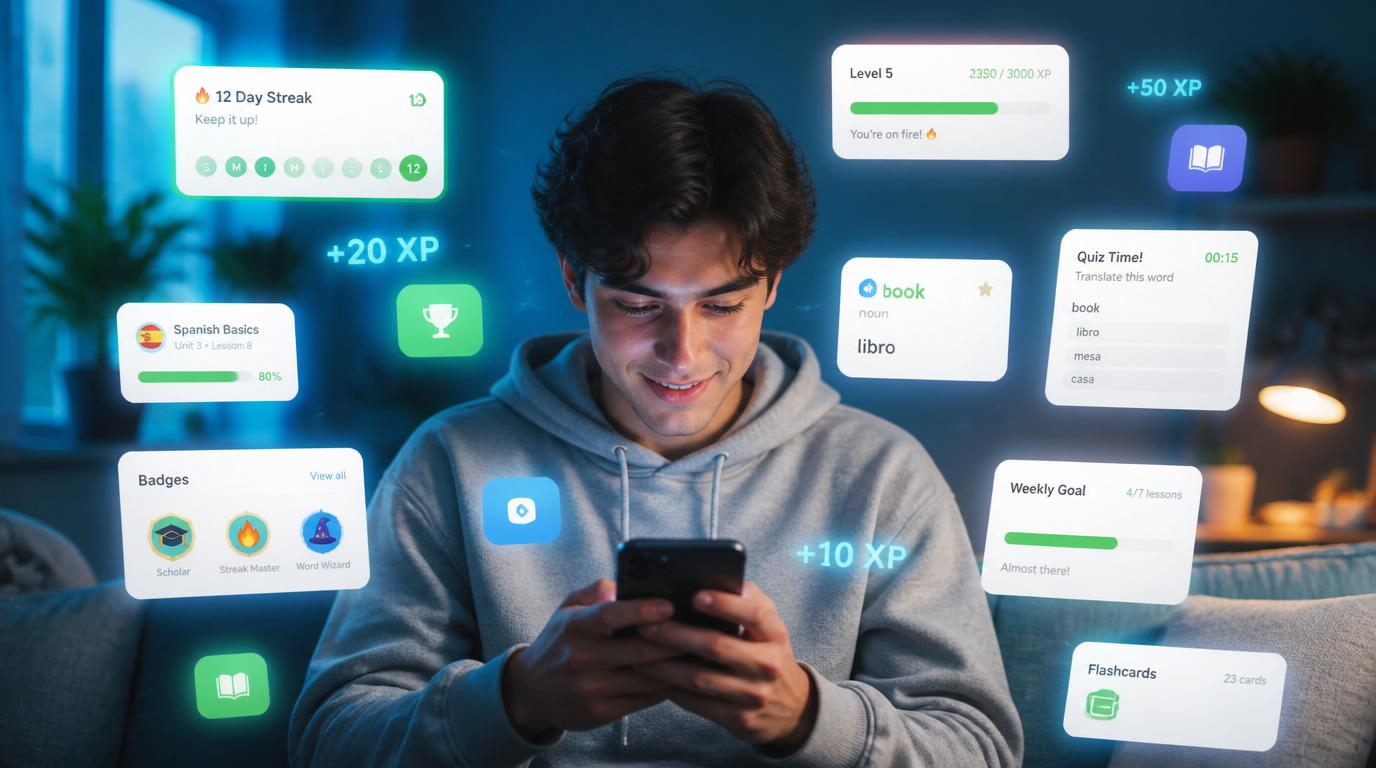
These systems are widely used in onboarding, skill development, reducing doomscrolling, discovering healthier social media alternatives, and supporting mobile learning. Typical features include:
- Progress bars that show exactly how much of a lesson is left.
- Points that track your total activity over time.
- Short lessons that reduce the cognitive load on your brain.
How Gamification Works Inside Learning Systems
Industry analysis from eLearning Industry shows that the above mechanics we mentioned work because they tap into human psychology and the desire for visible growth. Let’s see in detail:
Progress Tracking
Systems record every action you take. You see your completion levels as percentages or on a module map. For example, seeing a bar move toward 100% provides a visual sense of movement that keeps you moving toward the finish line.
Feedback Loops
Gamified systems provide an immediate response after each step. This is based on behavioral psychology. For example, when you get a correct answer or finish a unit, the system of the app or platform confirms it, which reinforces the behavior.
Repetition Through Short Sessions
When content is divided into small units, it is called microlearning. This structure reinforces memory through repetition. For example, you can interact with the material for ten minutes every day and improve with continuous learning in the long run. Now, let’s look at some examples and tips below!
1. Reading Summaries in Short Sessions
You can use apps that help you read more. For example, the Headway app is a nonfiction summary app focused on short reading sessions. It addresses the problem of long reading times and the low consistency many of us face when trying to finish a 300-page book. The app has over 55M+ downloads across many countries and has received the App Store Editors’ Choice recognition.
How is it useful, and what gamified e-learning experience does it provide? Let’s say you open the app during a commute or while waiting in line. In these moments, long books feel hard to continue. With Headway, you can read one summary in about 15 minutes and review key ideas immediately after.
This allows you to complete learning sessions more often. The app includes gamified features that support short learning sessions:
- Daily summaries appear based on your specific reading habits
- Audio mode lets you listen while you are moving or exercising
- Highlights store key points so you can find them later
- Visual cards explain complex concepts through simple imagery
2. Practicing Daily Lessons Through Tasks and Rewards
Let’s take the Duolingo app as an example: a language-learning solution that uses streaks and rewards to prevent irregular practice and low retention. The platform has over 500 million users globally. It is often cited among the best apps for learning because of its high engagement.
You can use it during short breaks because traditional language courses require long, scheduled sessions. You can complete one lesson in 5–10 minutes and repeat a block through an adaptive system. This forms a daily habit through streak tracking. Key features:
- Streak counter: Track how many days in a row you have practiced
- XP points: Reflect your total activity and effort
- Adaptive difficulty: The system adjusts tasks based on your performance
3. Answering Questions in Timed Rounds
You can find many quiz-based apps and platforms that help address the problem of passive learning. It is used in universities and even by companies worldwide to make training sessions more interactive.
You can join a session during a workshop and answer timed questions on your device. You can also see your ranking on a screen after each round. This immediate comparison increases engagement and focus, where you get:
- Live quizzes that create a social learning environment
- Leaderboard system to show top performers
- Real-time feedback on every answer
4. Tracking Progress Through Modules
If we take one of the most popular learning platforms as an example, which is Coursera, it offers online courses with structured milestones, you will find how it helps to reduce the drop-off rates that are common in long-term education. The completion rates improve when students have clear progress tracking.
That is why Coursera offers users the opportunity to study in scheduled sessions and complete modules step by step, using gamification processes. The visible progress keeps you going through difficult technical subjects. The solution provides:
- Completion badges for each finished section
- Weekly goals that help you manage your time
- Progress indicators showing your path through the whole specialization
5. Reviewing Material With Repetition
There are platforms and apps that offer gamification e-learning within a flashcard system to help users who have difficulty remembering large amounts of information. It is a standard tool used by students globally for exam preparation.
You can revise during short study sessions by reviewing digital flashcards. It is easier to repeat difficult terms until they are memorized. This repetition is the core of how the app improves memory.
How to Use Gamification in Your Learning Routine
Applying these principles to your own life does not require complex software. You can even use the mechanics of gamification in e-learning manually. You can focus on:
- Setting Short Sessions: Limit your learning to 10–15 minute blocks, as this makes the task feel manageable and prevents the urge to procrastinate.
- Tracking Completion: Use a simple checklist or a progress indicator. Seeing a row of checked boxes provides the same psychological reward as a digital progress bar.
- Repeating Key Concepts: Do not move to a new topic until you have reinforced the current one. You can use short review sessions to keep information fresh in your mind.
Test the Methods and Apps to See How Gamification eLearning Fits Daily Learning
Understanding what is gamification elearning helps us compare tools based on how we actually use them. These systems show that short sessions improve consistency and help us stay on track with our goals. You can also use a microlearning method that fits into a busy daily routine, as it requires very little time to get started.
You can test one method in your schedule today, and later, adjust your choice based on how you prefer to study. You can also use the apps during idle time, as they can help you build new learning habits or complete a single session each day. Remember, your performance and memory improve through consistent repetition!