
Launching or expanding an online casino ultimately comes down to the quality of its games, and the studio behind them decides how good those games can get. A casino game development company takes a concept from a blank page to a certified, revenue-generating title: it designs the math, produces the art, builds the client and server code, and walks the game through laboratory testing. Choose the wrong partner and you pay for it twice — once in delays at certification, and again in player retention once the game is live. This article explains what these studios actually do, how to evaluate them, which warning signs deserve attention, and what to settle in the contract before signing.
What a Casino Game Development Company Does
Full-cycle studios cover the entire production chain for real-money games. The scope you should expect from any serious provider of casino game development services includes:
Slot and table game production. Five-reel and three-reel video slots, cluster and ways mechanics, plus RNG table games such as roulette, blackjack, baccarat, and video poker. Live dealer is a separate, specialized discipline that most slot-focused studios do not cover.
Mathematics. Every real-money game starts as a math model: paytables, reel strips or symbol distributions, bonus feature logic, and simulation reports that confirm the theoretical RTP (return to player), volatility, and hit frequency before a single line of client code is written.
Game art and sound. Concept art, symbol sets, backgrounds, character animation, interface design, and audio produced to the technical requirements of each target market and platform.
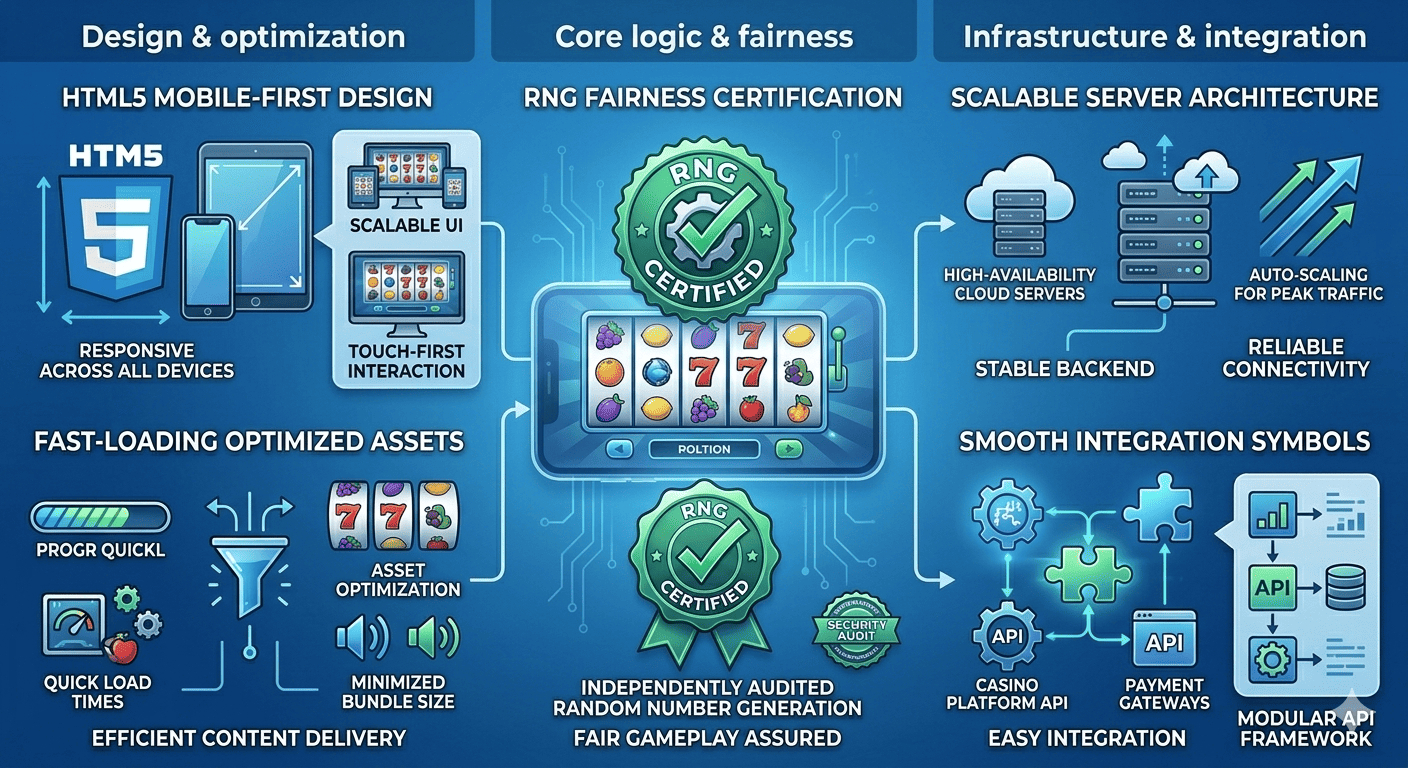
Remote Game Server (RGS). Certified game logic has to run server-side. The RGS draws outcomes, enforces game rules, exchanges balance updates with operator wallets, and lets one title be distributed to many platforms with identical, auditable behavior.
Certification support. Studios prepare the technical documentation that testing laboratories such as GLI, eCOGRA, and iTech Labs require, respond to their findings, and manage re-certification whenever game logic changes.
Back-office tooling. Game configuration, promotional campaigns, and reporting, so your operations team can run live content without raising engineering tickets for every campaign.
How to Evaluate a Casino Game Development Partner
Five areas separate studios that ship from studios that stall. Press each one hard during due diligence:
Portfolio with verifiable releases. Ask for games that are live in operator lobbies today, not concept art. Play them. Check load times on mid-range mobile devices, animation quality, and how bonus features behave across real sessions. A studio that can only show mockups is a studio you would be funding as its R&D department.
Mathematical expertise in-house. Request a sample PAR sheet — the paytable and reel documentation behind a game — and a simulation report. A studio with its own mathematicians can explain why the model lands on its target RTP and volatility; one that outsources the math will struggle to tune or extend the game later. If you want to understand the mechanics underneath, our explainer on how online slots work covers the RNG side.
Certification track record. Ask which laboratories the studio has passed games with and in which jurisdictions — the MGA, Curaçao, and the UKGC each impose distinct requirements. A partner that has already certified games in your target market removes the single largest source of launch delay.
Security posture. Outcomes must be server-authoritative, wallet callbacks authenticated and idempotent, and production access tightly controlled. Ask specifically how the studio prevents outcome manipulation, how secrets are stored, and what its incident response process looks like.
Communication and process. A named project manager, a fixed sprint cadence, staging builds you can test, and documentation delivered alongside the code — not after. Poor communication during the sales cycle never improves after signing.
Red Flags to Watch For
Walk away, or commit to substantially deeper due diligence, when you see:
- No verifiable live games — only reels of concept art and pitch decks.
- Game logic or RNG running in the browser client, where it can be inspected and tampered with.
- No in-house mathematician and no willingness to share the math documentation behind a game.
- Vague answers about certification: which labs, which standards, who pays for re-testing.
- Quotes far below market paired with guaranteed launch dates. Certification timelines are set by laboratories, not studios.
- Contracts in which the studio retains the art, math, or source code by default without saying so up front.
- No plan for post-launch support, bug fixes, or jurisdiction-specific updates.
Questions to Ask Before Signing
The contract is where an engagement with a casino game development company is protected or lost. Before signing, get written answers to:
- Who owns the IP, art source files, math documentation, and source code after final payment — and in what format is everything handed over?
- Which certification labs have you passed games with, and in which jurisdictions? Can we see the certificates?
- What exactly does the math deliverable include: PAR sheet, simulation report, RTP and volatility specifications per market?
- How does your RGS integrate with our platform: wallet debit, credit, and rollback flow; idempotency handling; free-round and tournament APIs?
- What is the support arrangement after launch, and how are bugs prioritized and fixed?
- How are scope changes priced, and what happens to the timeline when a laboratory requests changes?
- Can you provide a staging environment and a playable demo build before contract?
In-House vs Outsourcing vs Hybrid
There are three ways to get games built, and budget, time-to-market, and long-term ambition decide which one fits:
| Criterion | In-House Team | Outsourced Studio | Hybrid Model |
|---|---|---|---|
| Time to first release | Slow: months of recruiting before production starts | Fast: the studio is productive from week one | Faster than in-house; you keep architectural control |
| Upfront cost | Highest: salaries, tooling, management overhead | Lowest: fixed project pricing or per-game licensing | Moderate |
| Math and certification expertise | Must be recruited; a scarce profile | Usually in-house already and lab-proven | Studio covers math and certification |
| Roadmap control | Full | Defined by contract | Shared: you set priorities, the studio executes |
| Scalability | Every artist or developer is a separate hire | Capacity scales per project | Flexible core plus surge capacity |
| Best for | Large operators with a constant release cadence | Startups and operators without a game team | Operators with a core team that needs reinforcements |
For most operators and startups, outsourcing or a hybrid model wins. Building an internal studio only pays off when a full team — mathematician, artists, developers, QA, certification manager — stays continuously busy. Whichever route you take, vet providers against the same checklist, including full-cycle providers such as EJAW, which delivers casino game development from math model through certification support.
Frequently Asked Questions
How long does it take to develop a casino game?
A single online slot typically takes several months from approved concept to certified release. Art-heavy 3D titles and novel bonus mechanics extend the timeline, and laboratory certification adds weeks that depend on the jurisdiction and the lab’s queue. Table games built on well-understood math are usually faster than a feature-rich slot.
How much does casino game development cost?
Price is driven by four variables: art complexity (2D versus 3D and animation depth), math novelty, the number of target jurisdictions, and whether a new platform integration is required. A reskin of an existing certified game costs a fraction of a full custom title. Ask for itemized quotes so you compare scope rather than a single number.
Do I need a gambling license to launch these games?
Yes. The studio builds and certifies games, but the operator license — MGA, Curaçao, UKGC, or another regulator — sits with you or your platform partner. Games must be certified for every jurisdiction you serve, and some regulators add requirements such as RTP disclosure or restrictions on bonus-buy features.
Who owns the game after development?
Whatever the contract says. Work-for-hire agreements transfer IP to you on final payment; licensing models leave the studio with its framework while you receive exclusive or non-exclusive rights. Insist on written clarity about art source files, math documentation, and source code — verbal assurances are worthless at handover.
Gambling involves risk. Please play responsibly. This article is for informational purposes only.
If you are shortlisting partners, start from the scope you need and make every candidate prove each capability above against evidence: live games, PAR sheets, certificates. EJAW provides full-cycle casino game development services and can reinforce an existing team — you can hire slot game developers directly through us. Send over your target markets and feature list, and we will respond with a concrete delivery plan and team composition.