
Before a slot has reels, artwork, or sound, it is a set of probabilities. The slot math model is the structure that decides what a game can pay, how often it pays, and how wildly results swing along the way. For studios and operators, this model is the product: it defines the player experience, the financial profile of the game, and what a testing laboratory will certify. This article explains slot game math from a design and development perspective — what a math model contains, how RTP, volatility, and hit frequency interact, and how a model is simulated and certified before release.
What Is a Slot Math Model?
A slot math model is the complete probability structure of a game. It describes every possible outcome and the chance of each one, and it is built from a handful of components:
- Reel strips and symbol distribution — how often each symbol can land on each reel, whether on physical-style strips or weighted virtual reels.
- Paytable — what every combination pays relative to the current bet.
- Lines, ways, or cluster rules — how winning combinations are formed and evaluated.
- Feature mechanics — scatter odds, free spins triggers, multipliers, collection features, and their probabilities.
- Jackpot contributions — where a game feeds a fixed or progressive prize and how that prize can be won.
Everything players see — animation, sound, presentation of near misses — is an experience layer on top of this structure. The math model, not the artwork, determines the game’s long-term behavior, which is why professional studios lock the model before production art begins.
RTP: Return to Player
RTP is the percentage of all wagered money a game returns to players as prizes over its lifetime. It is a long-run statistical expectation, not a promise for a session: a game with 96% RTP returns 96 units per 100 wagered across a very large number of spins, while any single session can land far above or below that figure.
Most regulated video slots are designed within a 94–97% RTP band. RTP design is a commercial decision as much as a mathematical one: operator segments and markets have different expectations, and many providers ship several RTP variants of one title so an operator can match the requirement of its license. In most regulated jurisdictions the RTP must be disclosed in the game’s information screens, and regulators treat the published figure as a commitment the certified model has to honor.
Volatility: How Wins Are Distributed
Slot volatility — often called variance — describes how the same RTP is split across outcomes. Two games with identical RTP can feel completely different. A low volatility model pays smaller amounts more often, producing a steady rhythm of returns. A high volatility model concentrates the return in rarer, larger wins, which means longer quiet stretches punctuated by significant outcomes. Medium volatility blends the two. Labels are not standardized across the industry: each provider applies its own scale, which is why two games both marketed as high volatility can behave very differently in practice.
Hit Frequency and Max Win Probability
Hit frequency is the share of rounds that return any payout. Many modern video slots pay in roughly one of every three to five rounds, though the figure varies widely by design and there is no industry standard. Hit frequency shapes the felt pace of a game more than almost any other parameter: it determines how often the player receives feedback, regardless of the amounts involved.
Max win probability is the chance of the top outcome, usually expressed as 1 in N spins, paired with a maximum win cap expressed as a multiple of the bet — several thousand times the stake in many contemporary titles. These are design decisions with a fixed relationship: raising the max win while holding RTP constant necessarily lowers the probability of reaching it. The math model has to balance headline potential against the everyday rhythm players actually experience.
How the Math Model and RNG Produce an Outcome
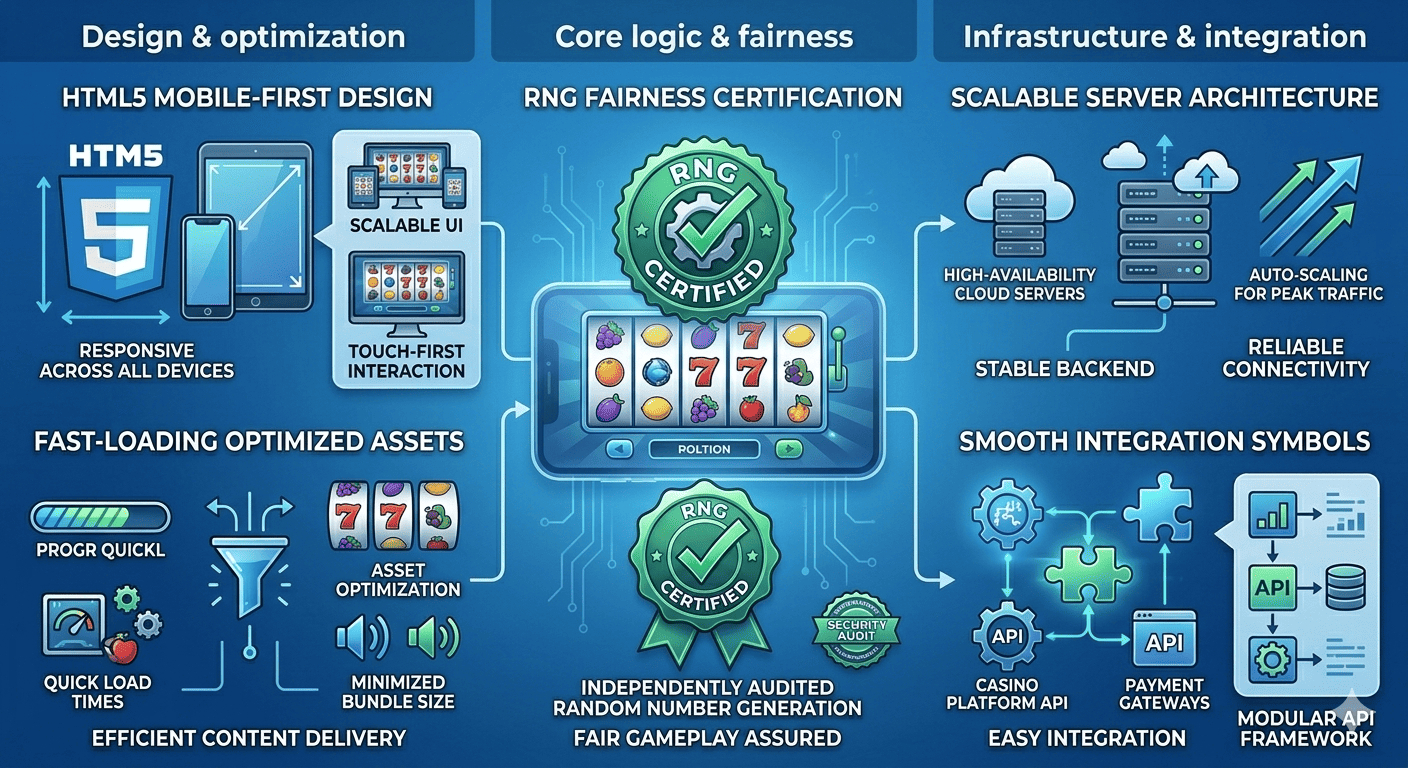
When a player presses spin, the random number generator produces a random value, the game maps that value to reel stops according to the model, the engine evaluates paylines, ways, or clusters against the paytable, and the result — win or loss — is recorded. In modern HTML5 games this calculation runs on the provider’s server; the client only animates the certified outcome. The RNG supplies the randomness, while the math model supplies the meaning: the same random value produces different outcomes in different games precisely because each game’s model weighs symbols and features differently. A fuller walkthrough of this pipeline is available in our article on how online slots work.
Simulation and Certification
A math model is proven by simulation, not by a few demo sessions. Studios run millions of simulated spins — often far more for complex games — and check that the simulated results match the theoretical design:
- Simulated RTP converges to the theoretical target within a defined tolerance.
- Hit frequency and feature trigger rates match the design specification.
- Max win probability and the full outcome distribution hold across bet sizes and feature buy options where applicable.
- Extreme cases behave within expectations: longest losing streaks, bankroll curves, and worst-case sequences.
Independent laboratories such as GLI and eCOGRA then review the model, the RNG, and the implementation before a game may launch in a regulated market, and licensing regimes like the Malta Gaming Authority (MGA) or Curaçao rely on those reports. Certification is also why math is treated as a controlled artifact: any later change to the paytable or trigger odds, however small, starts a new certification cycle.
How Math Shapes Game Design
The math model is where a slot’s design tradeoffs are decided. RTP can be held constant while volatility, hit frequency, and max win potential are rearranged — which is exactly how studios position games for different audiences. The typical contrast between low and high volatility designs looks like this:
| Design factor | Low volatility model | High volatility model |
|---|---|---|
| Win rhythm | Frequent smaller wins | Rare, larger wins |
| Hit frequency | Higher | Lower |
| Max win potential | Modest | Significantly higher, often thousands of times the bet |
| Bonus features | Frequent triggers, modest multipliers | Rare triggers with high multiplier potential |
| Session feel | Steadier balance, longer play on a smaller budget | Bigger swings in both directions |
| Typical audience | Casual players and longer sessions | Players chasing headline outcomes |
Neither profile is inherently better — the choice follows the game’s positioning, the operator’s audience, and the studio’s portfolio strategy. What separates professional work from guesswork is that the distribution is engineered deliberately, then verified by simulation, rather than discovered after launch. Studios without in-house probability specialists commonly hire slot game developers who combine math modeling with game design experience for exactly this reason.
FAQ
What does RTP mean on a slot?
RTP stands for Return to Player: the percentage of all wagered money the game is designed to pay back as prizes over its lifetime, typically in the 94–97% range for regulated online slots and disclosed in the game’s information screens.
Does a higher RTP mean a better game?
Not by itself. RTP says how much is returned over the long run, while volatility says how it is distributed. A 96% game with high volatility plays very differently from a 96% game with low volatility, and the “better” choice depends on the player and the operator’s audience.
Are online slot outcomes really random?
Yes. Outcomes come from a certified random number generator evaluated against the game’s math model, and testing laboratories verify both before release. Presentation elements such as reel animations happen after the result is fixed.
Who verifies that a slot pays its stated RTP?
The studio first, through millions of simulated spins, and then independent certification laboratories such as GLI or eCOGRA, whose reports support licensing in regulated markets. Regulators treat the published RTP as a commitment the certified model must match.
Can a slot’s volatility be changed after release?
Changing the math produces a new version of the game and requires fresh certification. In practice, providers ship separate RTP or volatility variants of a title rather than altering a live, certified model.
Gambling involves risk. Please play responsibly. This article is for informational purposes only.
EJAW develops slot games where the math model, the RNG integration, and the player experience are designed together and verified before release. If you are planning a new title or want a second pair of eyes on an existing model, explore our slot game development services — from math design and simulation to certified, RGS-ready delivery.