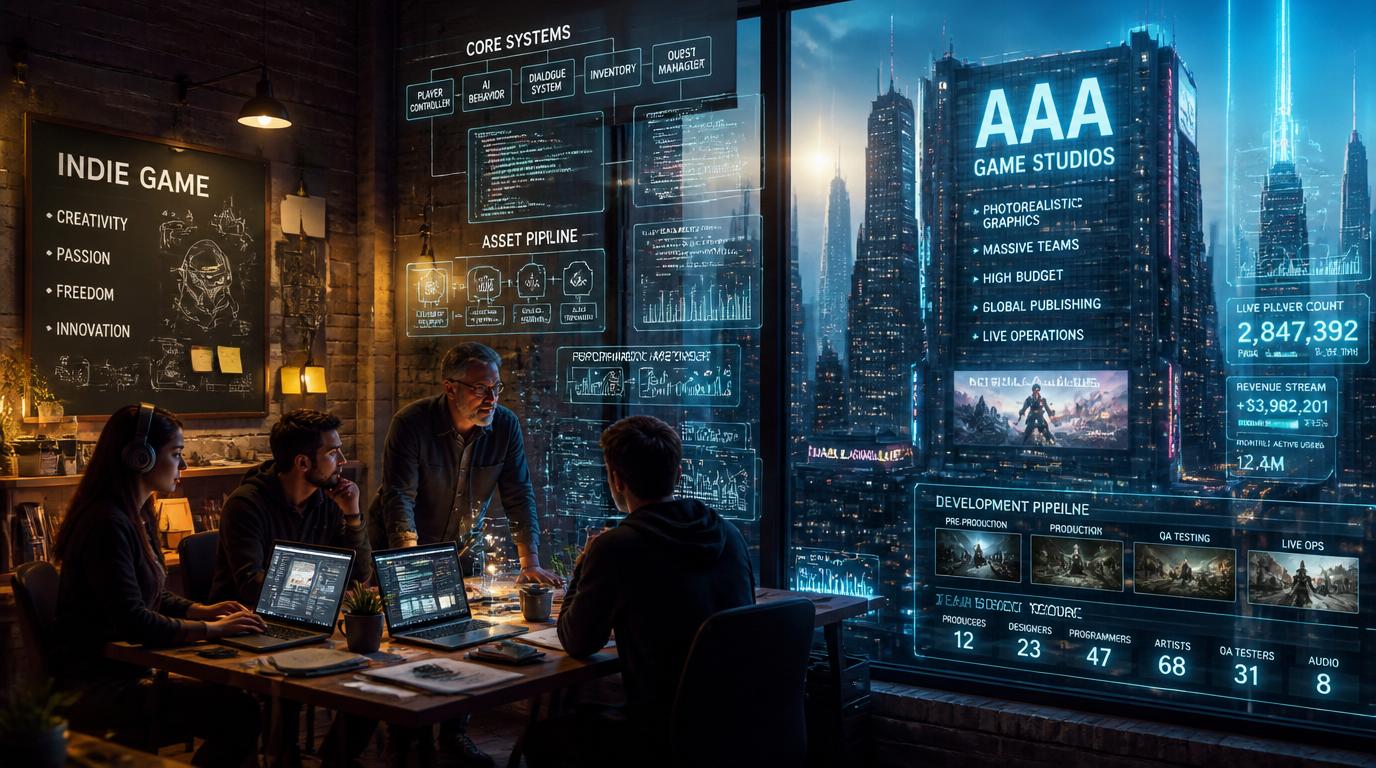

Ten years ago, almost every game developer took it for granted that making a hit game meant having the whole team physically under one roof. Designers could tap a programmer on the shoulder. A technical lead could glance over someone’s screen. Producers ran everything through face-to-face standups. The studios that did operate across locations were seen as outliers — brave, slightly chaotic experiments.
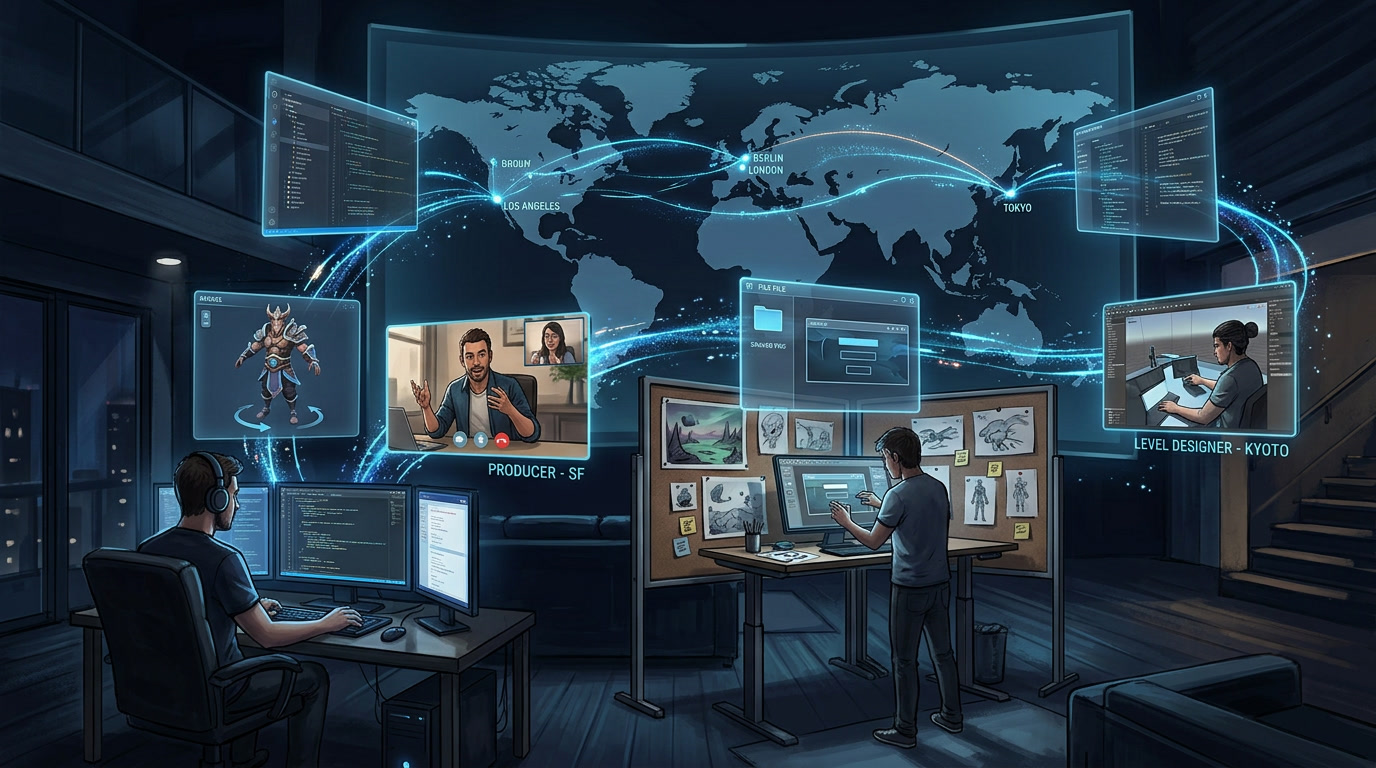
Today that picture looks completely different. Remote game development is not a workaround or a pandemic-era compromise. It has become the dominant model for most of the industry. Indie studios recruit globally from day one. AAA game development teams routinely span three or four continents. Game development outsourcing partners now contribute to titles from virtually every part of the world, with teams handling everything from environment art to backend engineering without ever meeting in person.
Yet for all how common it has become, remote game development is still genuinely hard. Building a game requires tight, sustained collaboration across disciplines. Art, code, design, and audio are not independent tracks — they intersect constantly, and the intersections require fast feedback. Assets get large. Iterations get frequent. IP needs protecting. And the bigger the project, the more all of this compounds. Studios that simply handed laptops to their team and called it “remote work” found out quickly that the approach does not scale.
The ones that actually succeed have done something more fundamental. They have rebuilt their infrastructure — version control, asset management, build pipelines, communication, security — from the ground up with distributed work in mind. Here is what that actually looks like.
Version Control Is the Foundation, Not an Afterthought
If there is one technical system that separates functional distributed studios from dysfunctional ones, it is version control. And in game development, version control is a harder problem than it is in most software disciplines.
A typical game production combines source code with textures, animations, audio files, cinematics, and 3D assets that can run into hundreds of gigabytes. Managing all of that across a distributed team — while keeping everyone on the same version and avoiding conflicts — requires tooling that was purpose-built for the job.
Perforce Helix Core remains the industry standard at the AAA level precisely because it handles large binary assets well. Teams working in Unreal Engine rely on Perforce heavily — its asset locking features mean that when one artist is working on a file, nobody else accidentally overwrites it. On a project with hundreds of developers, that kind of discipline is not optional.
GitHub is still the go-to for indie studios and smaller teams. Git is excellent at tracking code changes, though storing large game assets requires adding Git LFS to the workflow. For indie game development teams building small to medium projects while spread across multiple cities, it works well once properly configured.
Plastic SCM has become the preferred choice for many Unity game development teams. Its visual branch workflow and merge tooling appeal to studios where artists and non-technical contributors need to interact with the repository directly, not just developers.
The specific platform matters less than the discipline around it. Version control only works if everyone uses it the same way, every time.
Cloud-Based Asset Management: One Source of Truth for Everything
Modern game productions generate staggering amounts of content. A single title might involve thousands of textures, hundreds of 3D models, mocap sessions, voice recordings, cinematics, design documentation, and technical specifications — all evolving simultaneously across different teams.
Without centralized asset management, distributed teams lose track fast. Which version of that character model is approved for production? Did someone already fix that texture seam? Is this the final audio mix or a placeholder? These questions seem minor in isolation. Across a full production, they become a constant drain on time and energy.
Cloud-based asset repositories give every team member access to a single source of truth. Combined with automated asset tracking systems, they let artists in one location, designers in another, and engineers in a third all work from the same baseline without stepping on each other.
This is not just a storage question. It is about maintaining visibility, consistency, and accountability across every phase of production. Studios that get this right — including those handling complex work like 3D game modeling, animation and VFX, and concept art — report dramatically fewer integration headaches at the back end of production.
Automated Build Pipelines: Remove the Manual Work
Manual processes are the enemy of remote productivity. When every test run, every asset validation, every build package has to be triggered by a human who is possibly in a different time zone, bottlenecks multiply fast.
The studios that manage distributed development well invest heavily in continuous integration and continuous deployment pipelines. Automated systems handle code compilation, testing, asset validation, build packaging, deployment to test environments, and performance monitoring — without anyone having to babysit the process.
Common tooling includes Jenkins, TeamCity, GitHub Actions, and Azure DevOps. The specifics vary, but the principle is the same everywhere: automation handles the repeatable work so developers can focus on the work that actually requires human judgment.
This matters even more at scale. Whether you are running a mobile game development project with a small team or a full 3D game development production with dozens of contributors, the overhead of manual build management grows proportionally with team size. Automation flattens that curve.
Communication Has to Be Structured, Not Just Available
Remote development does not usually break down because people stopped communicating. It breaks down because communication became chaotic — too many channels, too little documentation, too many decisions that lived only in someone’s memory.
The studios that handle this well are deliberate about structure.
Instant messaging tools like Slack, Discord, and Microsoft Teams handle quick discussions and daily coordination well. But experienced teams do not treat chat as the authoritative record of project decisions. If something important gets decided in a thread, it gets documented somewhere more permanent.
Asynchronous communication is not a workaround for time zone differences — it is a genuine advantage when used well. Properly written design notes, recorded meetings, documented decisions, and a well-maintained wiki mean that a developer starting their day in Kyiv does not need to wait for colleagues in Los Angeles to come online to understand what was agreed yesterday. This reduces the pressure to be “always on” while actually improving information flow.
Project management tools like Jira, ClickUp, Linear, and Asana give teams real-time visibility into what is in progress, what is blocked, and what needs to happen next. The platform matters less than the discipline of using it. Every task needs a clear owner, a due date, a priority level, and relevant context attached. Teams that maintain that discipline stay productive regardless of geography. You can read more about how studios use Jira, Confluence, and Bitbucket together to build effective distributed workflows.
Keeping Creative Vision Aligned Across Time Zones
This is the challenge that does not get talked about enough. Tools and pipelines can be optimized. Creative consistency is harder to systematize, and it is where distributed productions most often drift.
A game is not a collection of independent assets. It is a single coherent creative work — and that coherence has to be actively maintained when the people building it rarely share the same working hours.
Studios that manage this invest in documentation. Not bureaucratic documentation, but the kind that actually transfers vision: thorough art bibles, clear design pillars, narrative guidelines, technical standards, gameplay reference videos, visual mood boards. They run regular content review sessions that keep all disciplines aligned. They treat creative drift as an infrastructure problem with infrastructure solutions.
This is especially important for work that requires tight aesthetic coordination — character design, environment design, UI/UX design, and game level design all require shared visual language. When that language is documented well, teams in different locations can contribute to the same vision without constant synchronization calls.
Code Reviews Matter More in Distributed Teams
When a team is co-located, technical knowledge spreads informally. Someone overhears a conversation, a developer looks over a colleague’s shoulder, questions get answered in passing. That informal layer disappears in a distributed team.
Code reviews fill the gap. In distributed studios that do this well, reviews are not just quality gates — they are structured knowledge transfer. They catch quality issues, enforce consistency, flag security concerns, and spread design understanding across the codebase. New developers integrate faster because the review process gives them a structured way to learn how decisions get made.
Teams with strong review practices consistently have fewer production problems, and they onboard new contributors more smoothly. For game testing teams especially, clear code standards supported by disciplined review processes reduce the bug surface area significantly.
Security Is a Core Operational Requirement
A developer working from home, a café, or a coworking space in another country represents a real security challenge. Studios building commercial games have valuable assets to protect: custom engines, unreleased source code, unannounced projects, licensing agreements, financial data.
One breach can be genuinely catastrophic — both financially and in terms of the trust of publishers, partners, and players.
This is why security in serious distributed studios is treated as a core operational function, not a compliance checkbox. That means mandatory multi-factor authentication, endpoint protection on every device used for work, clear policies on what devices are permitted, strict access control, data encryption, and regular security audits.
Related to this is the question of network security — a topic that grows more important as game development teams become more distributed. Studios handling sensitive infrastructure often use dedicated IP VPNs, where developers are assigned fixed, whitelisted IP addresses rather than sharing pool addresses that can trigger authentication issues. For iGaming remote server infrastructure in particular, stable network identity is not a nice-to-have. It is a basic operational requirement. If you are thinking about what this looks like in practice, the article on why remote gaming servers matter breaks it down well.
One of the solutions to this problem is to use a dedicated IP VPN where the developers are assigned a fixed and exclusive IP address which is then whitelisted by the internal systems. Teams looking into this possibility might want to see PIA’s dedicated IP feature page for details. For distributed studios handling sensitive infrastructure, a stable network identity is not only beneficial for security but also helpful for access management. A reliable connection is, of course, the backbone of any remote development work that drives high productivity. It may not be flashy, but its role is indisputably significant.
What Makes a Remote Studio Work
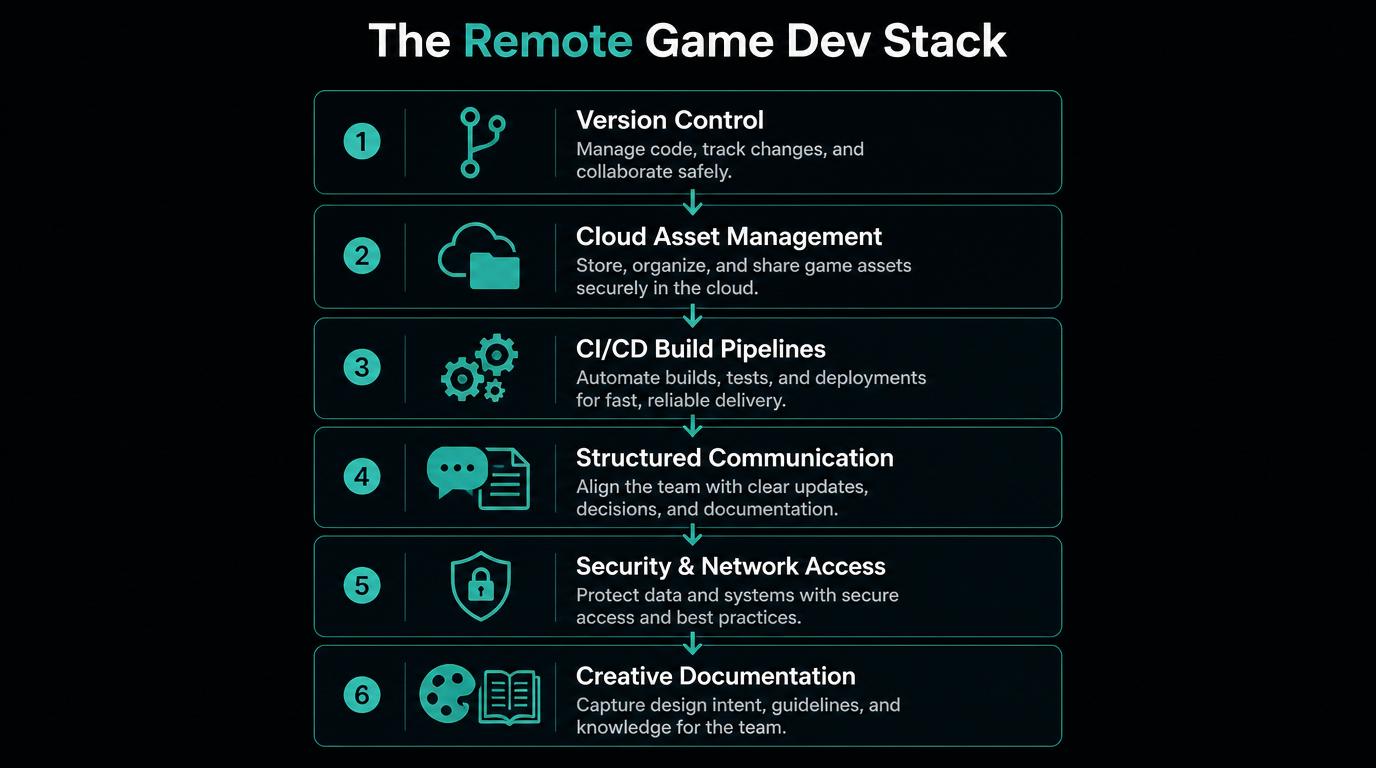
Looking across the studios that do distributed development well, the pattern is consistent: technology is necessary but not sufficient. The tools have to be right, and so do the workflows built around them.
Version control treated as a core system rather than an afterthought. Asset management that gives every contributor confidence they are working from the right files. Build automation that removes manual friction from the process. Communication structures that make information findable without requiring everyone to be online at the same time. Documentation that maintains creative alignment across disciplines and time zones. Security practices that protect the studio’s most valuable assets. And reliable network infrastructure that lets developers access internal systems without interruption.
When these things are in place — whether you are building mobile games, VR experiences, hyper-casual titles, or anything else — the physical location of the people doing the work becomes much less relevant.
The Industry Has Changed Permanently
Remote game development started as a contingency for many studios. It has become something different: a structural advantage for studios that execute it well.
Access to global talent. Flexible team scaling. The ability to run game development outsourcing partnerships across multiple time zones without losing coordination — these are not theoretical benefits. Studios that have built the right infrastructure are already realizing them.
The barrier to entry is real, though. Simply allowing people to work from home is not the same as building a distributed studio. The difference is in the systems: who owns version control decisions, how assets are tracked, what gets automated, how communication gets structured, how creative direction gets documented, and how security gets enforced.
Get those systems right, and teams that have never been in the same room can build excellent games on schedule at scale. That is what the best distributed studios have already figured out — and what the rest of the industry is still catching up to.